Blog

The Beginner’s Guide to the Law of Small Numbers

Humans are social beings by their very nature. We generally try to emulate other people’s behavior and follow the norms so that we do not stand out from the rest unless your name is Napoleon Dynamite.

In most instances, people base their decisions on a simple logic – if so many people are doing it, it must be right, so I must do it too.

This is why you often come across commercials that claim that ‘three out of five dentists recommend this mouthwash’, ‘seven out of ten people are satisfied with this vacuum cleaner’, and so on. The idea is to convey a message – ‘so many people are using it, so must you’.

The problem, however, with Continue reading “The Beginner’s Guide to the Law of Small Numbers”
What is Anti-fragility?

If you think the Black Swan by Nassim Taleb was complex, try interpreting Taleb’s equally important masterpiece, titled ‘Antifragile: Things That Gain From Disorder’.

Nassim Nicholas Taleb created a flutter in the intellectual world with his seminal work Black Swan. The book makes you think and question the values and suppositions by which you live your life.

However, Taleb’s Antifragile makes you introspect even more. Chances are that your mind will be overwhelmed with a triad of: FRAGILE – ROBUST – ANTIFRAGILE.

Each of these represents a concept or a categorization developed by Taleb. None of them hold relevance in classroom curriculums Continue reading “What is Anti-fragility?”

Opening the Book on Gresham’s Law

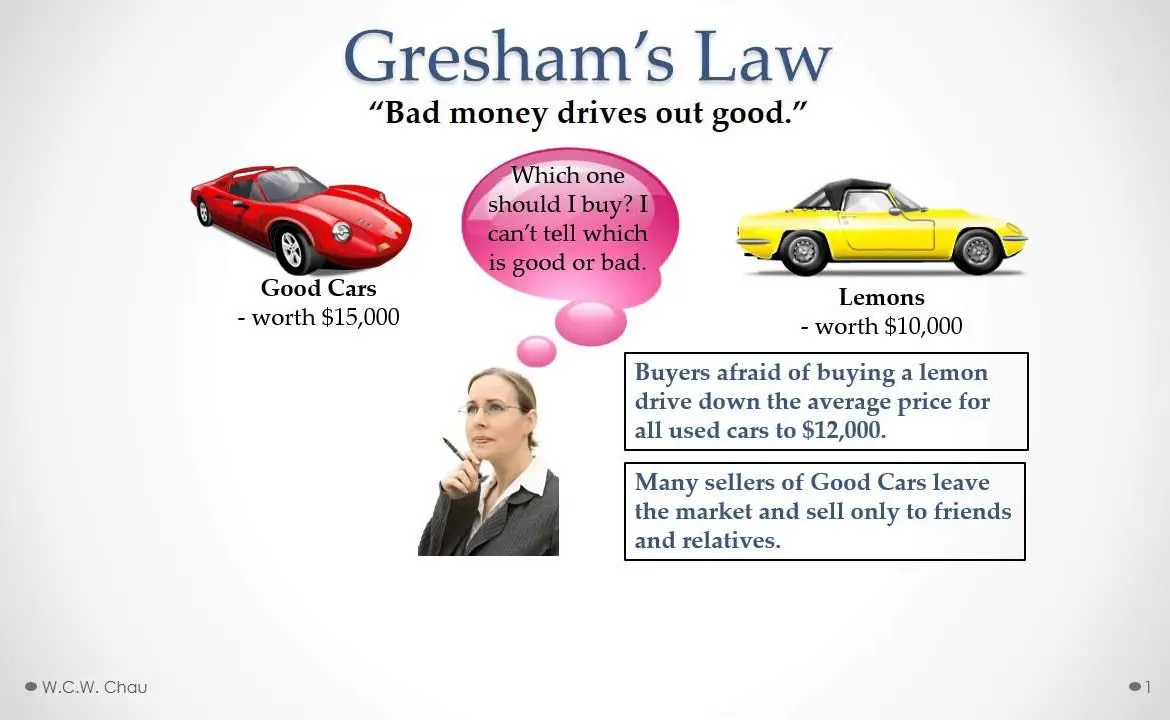
Gresham’s Law is essentially a monetary observation of how people tend to use currency when both, old and new currency is in circulation. To some extent, it is still applicable to modern economic situations.

History of Gresham’s Law – a Case of Good and Bad Shillings

The easiest way to describe Gresham’s Law is to say that “bad” money tends to drive away “good” money. However, the good and bad in currency can be confusing.

This principle originated during a time in history when currency was circulated in the form of coins. Sir Thomas Gresham was one of the more noted financial advisers to Queen Elizabeth I. During his tenure, he Continue reading “Opening the Book on Gresham’s Law”

Discussing The Lindy Effect

The Lindy Effect gained its named from a deli in New York, named LINDY’S. The idea was proposed by Albert Goldman. A standout author, he explained how the Lindy Effect has relevance in many real-life situations.

The same was later popularized by intellectuals and influencers like Nassim Taleb who detailed the theory in Antifragile—his 2012 book that has won rave reviews and continues to arouse a lot of curiosity.

The idea has been recreated, argued with and repeatedly explained by many physicists, mathematicians, and thinkers. The explanations continue, and so does the charm of this interesting concept.

What is the Lindy Effect?

Continue reading “Discussing The Lindy Effect”

The Concept of Exaptation and Its Relevance in Modern Life

Evolution is all about change. Having started as unicellular organisms, we have now evolved into the most intelligent species on the planet (Harry Solomon in Third Rock From The Sun was an alien – remember that!).

The process of evolution itself is highly complex and unpredictable to a certain extent. What starts as a basic trait or feature in an organism could evolve into something entirely different and serve a new purpose. This particular process is referred to as exaptation.

What Is It?

Exaptation is a concept in evolutionary biology which refers to the process in which an existing trait or feature changes its nature and function to serve Continue reading “The Concept of Exaptation and Its Relevance in Modern Life”

Dunbar’s Number and Its Relevance in Daily Life

What is the number of close friends and acquaintances you have in your social circle? For some people, it might be a count-on-one-hand list, for some others, it might be a large number.

The average human being, according to experts, is capable of maintaining stable, social relationships with 150 people, which is known as Dunbar’s Number.

What Is It?

Dunbar’s Number is a concept developed by British anthropologist Robin Dunbar. It is the number of social relationships that the average person is capable of developing and maintaining throughout their life. Dunbar developed this theory while studying the relationship between the brain size of primates Continue reading “Dunbar’s Number and Its Relevance in Daily Life”

Fundamental Attribution Error – What Is It and Why You Need to Avoid It?

One of the problems that we face at a societal level today is that we are too quick to judge each other (well if someone acts like Dylan did in Transformers 3 it is OK to judge them quickly but let’s get back on track). Any time something goes wrong, our first reaction is to judge the person responsible based on his or her character flaws. Maybe they were too greedy.

Maybe they were too stupid. Maybe they were too selfish. Maybe they were too arrogant.

We tend to get fixated on what we perceive as a character flaw and neglect all the other factors that could have contributed to the problem in the first place. Continue reading “Fundamental Attribution Error – What Is It and Why You Need to Avoid It?”

Matthew Effect and Its Manifestations in Daily Life

Have you ever wondered why some people seem to go from strength to strength in life while some others not only tend to get stuck in a rut, but actually regress over time? It is not merely ‘bad luck’ or ‘some people just do not have it in them’. It is a manifestation of what sociologists call the Matthew Effect.

What is it?

The Matthew Effect is a sociological concept that says that people who start out in life with an advantage, no matter how small it is, continue to benefit from it throughout their life while those who start out with a disadvantage, no matter how minor it is, continue to suffer the consequences throughout their life. Continue reading “Matthew Effect and Its Manifestations in Daily Life”

Renormalization Group

Renormalization Group (RG) is an advanced mental model that attempts to explain why scientific theories are often so effective, even when it is practically impossible to precisely determine all the parameters.

For instance, a human being is fundamentally a complex assemblage of interacting subatomic particles, but we are able to easily recognize humans from other species because we can  broadly identify their key physical and behavioral characteristics, without comprehending their electron configurations.

Such abstractions allow us to understand our macro world, but a key question that must be asked is: “why can we do that?” Continue reading “Renormalization Group”

Seize The Middle

The mental model “Seize the Middle” gained prominence following Emanuel Adler’s distinguished work: “Seizing the Middle Ground: Constructivism in World Politics.”

Prior to the emergence of this model, the field of international relations was largely influenced by two dominant approaches: realism and liberalism (or pluralism). But in recent decades, the approach of constructivism in international relations has been increasingly recognized as a more pragmatic approach that aims to “seize the middle ground.”

Anarchical System of World Politics

The theory of seizing the middle takes issue with liberal and realist assumptions related to Continue reading “Seize The Middle”