
Renormalization Group (RG) is an advanced mental model that attempts to explain why scientific theories are often so effective, even when it is practically impossible to precisely determine all the parameters.
For instance, a human being is fundamentally a complex assemblage of interacting subatomic particles, but we are able to easily recognize humans from other species because we can broadly identify their key physical and behavioral characteristics, without comprehending their electron configurations.
Such abstractions allow us to understand our macro world, but a key question that must be asked is: “why can we do that?” The Renormalization Group or RG model tries to provide an answer to this seemingly simple, but deeply fundamental question.
RG is the Reason Why Science Works so Well
Let us take gas as an example. We can typically describe a gas by its properties such as pressure, temperature, and density, without going into their intricate atomic makeup. This works well in science – when the scales are large enough, the underlying microscopic details are rendered irrelevant. At a practical level, our abstractions are the identification of various collective phenomena.
Scientific theories are so effective, in part, for this very reason. But it remains far from obvious why would a scientific theory of higher level behavior work so well when at a lower level there are so many uncertainties?
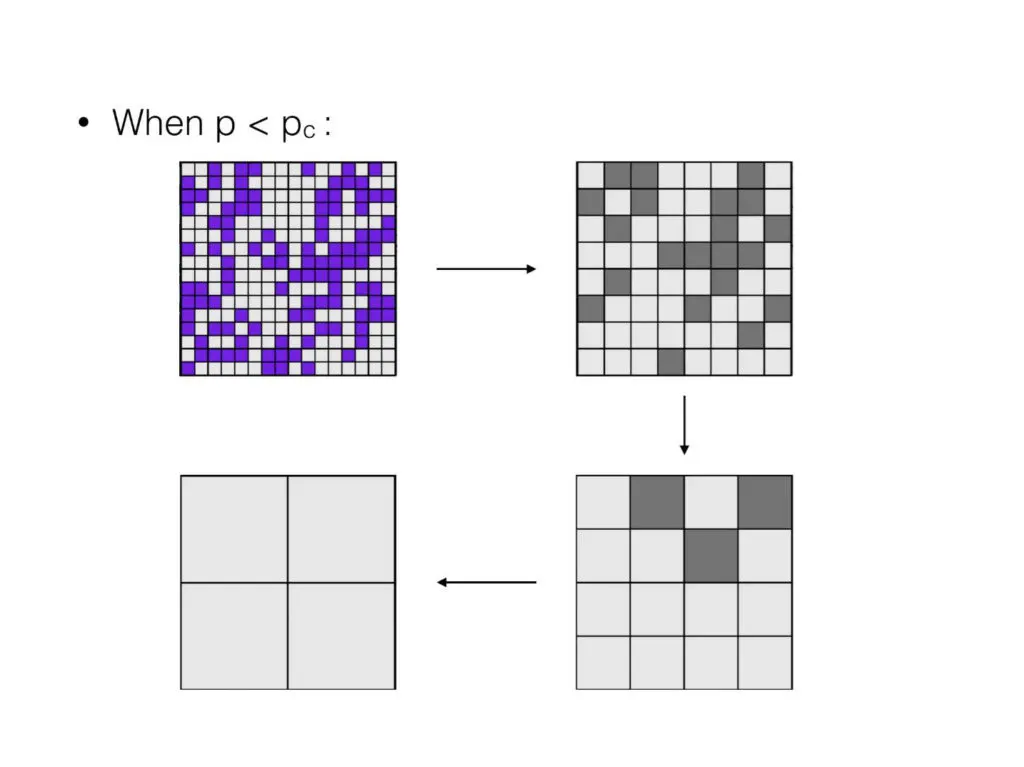
To get at the heart of the matter, let us consider a game of flipping coins.
If we flip a coin 100 times, we expect the average number of heads to be about fifty. But in reality, it may be forty or sixty. In a sense, we have coarse-grained the system to arrive at our estimates, which are fairly accurate. The more we coarse-grain our system (the larger the number of coin flips), the more accurate will be our estimates.
This phenomenon is so powerful in statistics it gets its own name: The Central Limit Theorem. This theorem is the consequence of a far deeper idea that is known as Renormalization Group.
Theory of Theories
RG in a sense is the “theory of theories” which explains how different microscopic details, when coarse-grained or zoomed out, tend to ‘flow’ to a common theory. The RG model was originally developed in the context of particle physics, and grew in its scope with the pioneering work of Kenneth G. Wilson in the 70s, for which he won the Nobel Prize.
Understanding the behavior of scientific phenomenon, including the universe itself, would be intractable if we needed to know every detail. RG, the abstract theory of theories, attempts to illuminate some aspects that contribute to the success of science.
Practical Application
The RG model could apply to the stock markets, monetary policy determination, business and industrial operations, and other areas that involve complex decision making. It is not possible to evaluate all the micro and macro factors, and the key lies in the observation and analysis of broad-level statistics, patterns, and trends in order to arrive at decisions that are close to being accurate.