
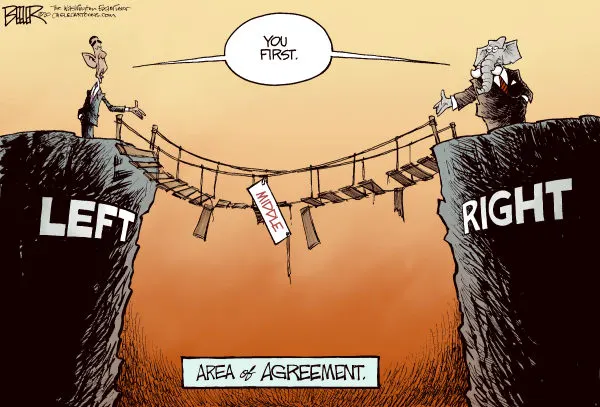
The mental model “Seize the Middle” gained prominence following Emanuel Adler’s distinguished work: “Seizing the Middle Ground: Constructivism in World Politics.”
Prior to the emergence of this model, the field of international relations was largely influenced by two dominant approaches: realism and liberalism (or pluralism). But in recent decades, the approach of constructivism in international relations has been increasingly recognized as a more pragmatic approach that aims to “seize the middle ground.”
Anarchical System of World Politics
The theory of seizing the middle takes issue with liberal and realist assumptions related to the international system. Constructivists put forth several arguments that are at a variance with those of the liberalists and realists. One of the salient points of departure arises from how these divergent theorists look at anarchy.
While all three of them recognize that the global political system is anarchical and there is no overarching power that cohesively governs world affairs, they disagree on the behavior of the state in this anarchical international system.
Realists see anarchy as a condition that creates state competition for power, security, and resources. Pluralists or liberalists, on the other hand, believe that even under anarchical system, cooperation among states is possible through international organizations (such as the UN, NATO, or G7 – even if NATO is basically the US since other countries in Europe don’t invest in their own safety or military like they should but this is another topic). Liberalists argue that these institutions generate positive gains for the states and are not restrained by the negatives of an anarchical global system.
Constructivists disagree with the position of the realists that anarchy inherently creates competition and wars. According to constructivists, the international anarchical system is essentially whatever the state actors want it to be. Anarchy by itself does not bring about peace or war. The actors of the day play a vital role in how they interpret the system. Their positions also shift and evolve over time.
Constructivists insist that state actors do not respond to the ‘given’ anarchical conditions, they create them.
A Classic Example
A classic example in the arena of international politics is that of a stag hunt, where all hunters go after the stag. The realist believes that there is no incentive for the hunters to cooperate and work together in the hunt, and each should look out for their own interest and survival – even at the cost of the larger benefit that can be attained through cooperation.
The reason is that it is pointless to trust the motivations of other actors in a “self-help” system with no central governing power.
Constructivists, however, argue that at least in the beginning of the game, there is no reason for the states to assume others as threats, or even as cooperative partners. In international relations, according to constructivists, states often act based on their culture, identity, interests, and relationship with other states.
Current Scenario
The US military power perceives British missiles differently from North Korean missiles. One is viewed as a friend, the other an enemy. To achieve success in international relations, it is critical to seize the middle ground, and generate interactions with the perceived enemy (North Korea in this case).
Continued interaction can lead to a discovery of commonalities over time, and what may appear to be a totally pessimistic relationship at the first meeting may gradually turn into friendship or at least a non-enemy relationship (such as what exists now between the US and Vietnam).