
Survivorship bias is essentially a prejudiced mindset where people have a distorted view about situations and events, focusing only on the glorious or successful aspects, ignoring the underlying toil and failures.
Survivorship bias is commonly seen in entrepreneurship. We know that every struggle to become an independent business owner does not mature into a brand that the world worships.
Every account of people putting their entire life’s savings into a start-up does not have a happy ending. However, some people choose to ignore the truth in its entirety. Here, survivorship bias exists in the form of people looking only at the brilliance of successful entrepreneurs.
This skewed mindset chooses to concentrate on the handful of folks who went against the common wisdom of completing formal education, undergoing professional training or paying their dues in the workplace to climb-up the corporate hierarchy.
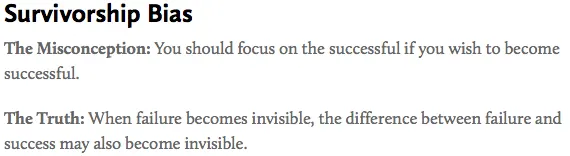
Within this fraction of world-renowned entrepreneurs, some managed to create multi-million or billion dollar enterprises. However, the success rate is still peanuts, too miniscule to conclude that giving-up your regular job is the only way ahead to becoming a successful entrepreneur.
Don’t live a lie: believing failure doesn’t exist is a fallacy
Being a risk-taker is very different from being blind to the possible damages. People with survivorship bias seem less informed, not reading the entire story.
There is nothing wrong with focusing on the positive and being overly optimistic but survivorship bias can impair your growth as an individual whether your goal is a happy marriage or making millions via the volatile equity market. This is because being aware about real-life accounts of failure are as critical as reading about success stories.
Without this reality-check, the smallest failures can leave you very vulnerable, unable to manage the situation. This is when life spirals out of control and you are left exposed, without a back-up plan, without any resistance against a contingency that was always probable.
Survivorship bias is often believing in what vindicates your choices
From movie stars with cult-like status to extraordinary athletes and smartphone app creators, there are plenty of real life accounts where the glory came because of going through an unforgiving amount of hard work.
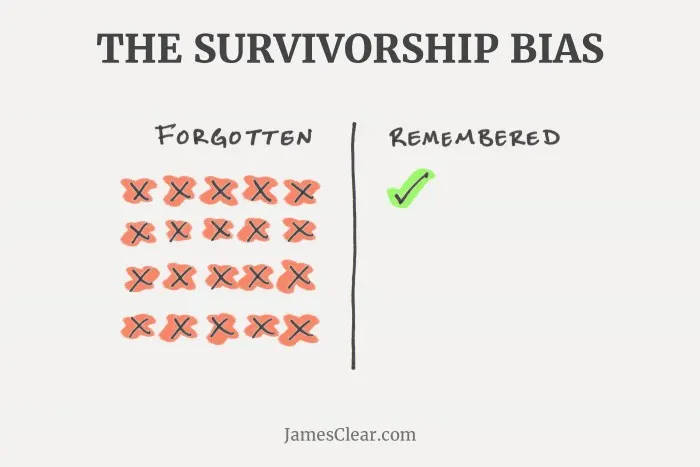
However, a person with survivorship bias might choose to focus on the fact that a lot of these highly determined people were high school dropouts – this is a highly biased and self-damaging way to look at things. The grandeur of these achievers does not imply that it is necessary to get kicked out of high school to achieve that status!
Understanding survivorship bias in more regular scenarios
A biased mindset can raise expectations unrealistically, leaving you unable to manage situations when things don’t proceed as planned.
Survivorship bias can make you gravitate towards trending lifestyle gurus or investment celebrities. You tend to believe the hype without understanding the struggles and repeated failures involved in achieving incredible success. You can suffer from survivorship bias in many everyday scenarios.
For instance, you may sign-up for a blind dating website. These sites promise high chances of people finding a compatible or very likeable date. However, there is no guarantee that everyone will find someone who piques their interests or shoots the arrow of cupid.
And there is one little detail that is unsaid about such websites – you can make some good friends since most attendees at such events have something in common, i.e. the need for someone with similar interests, lifestyle choices, or sense of style.
If you were to participate with a biased mindset, you will expect to find a suitable date with absolute conviction. This means setting-up yourself for utter disappointment if the candidates don’t match-up to your expectations. You would be too disillusioned, unable to accept the reality with negligible chances of cashing-in on the chance of finding some possibly great friends.
The big takeaway
You need to hold on to your beliefs despite being fully aware about what challenges it – that is real faith. When you can plan optimistically despite the possibly devastating downsides, you are more likely to remain driven no matter what life throws at you.
Being aware about the challenges means you have greater chances of developing effective coping mechanisms against failures, and moving on to the path of success.