
Melvin Dresher and Merrill Flood of the Rand Corporation first introduced the mental model called prisoner’s dilemma in 1950, which has since been recognized as one of the most famous game theories.
Prisoner’s dilemma essentially provides a framework to understand how to achieve a balance between two seemingly opposing forces – competition and cooperation. The concept is now used as an effective tool for making strategic decisions in the field of politics, economics, sociology, business, and finance.
How does it Work?
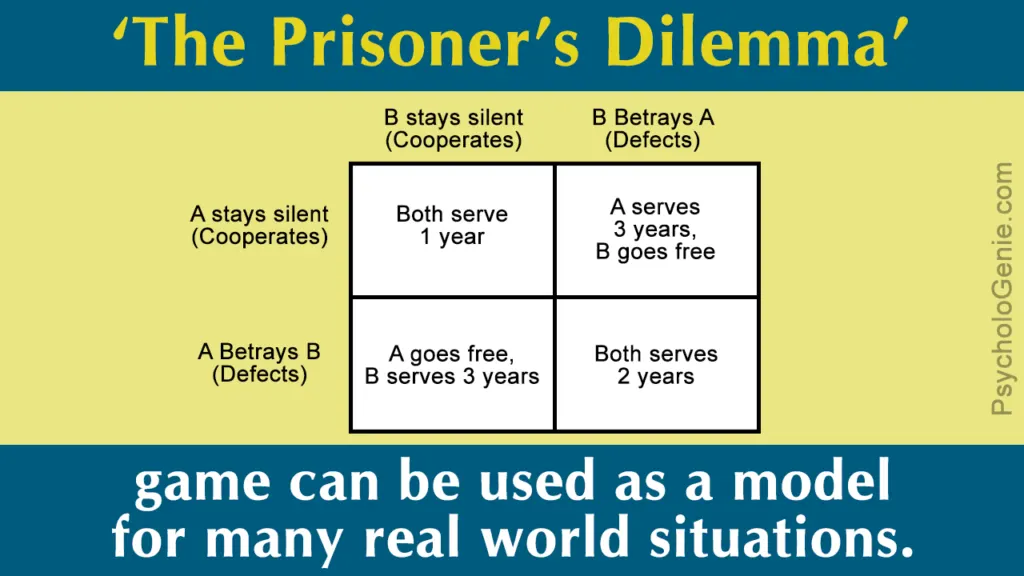
Prisoner’s dilemma game theory is about two criminal gang members (which are widespread in Chicago, LA, Baltimore, and so on) who are imprisoned and placed in solitary confinement with no way to communicate with each other. The prosecutors offer a bargain separately to each prisoner. They have an opportunity either to cooperate with their fellow prisoner by remaining silent or betray him by testifying against him.
Their offer is:
- If both betray each other, each gets a prison term of two years.
- If only one betrays the other, the betrayer will be released from prison, while the other (who did not betray) will get a prison term of three years.
- If both do not betray each other, both will get a prison term of only one year.
Real World Analysis
Many analysts believe that in the real world, there is no implicit trust and no cooperation – but only competition. Therefore, both prisoners will betray each other – because that will ensure that they at least do not get the prison term of three years (only the one who does not betray gets that prison term).
By betraying the other, they have some chance of either getting released from prison or serving two years in prison.
Had they chosen the route of cooperation, they would have each served only one year in prison (by not betraying each other).
But cooperation does not work in a “winner takes all” world.
Application in Business
If Coke cuts down its retail price, Pepsi will have no option but to follow suit. If Pepsi ‘cooperates’ by maintaining its high price in the hope that Coke will soon restore its original price, only Pepsi will lose. In the real world, Coke will maximize this opportunity to eat into Pepsi’s market share with continued lower price.
Had both companies chosen to ‘cooperate’ instead of ‘compete’, they could have enjoyed higher prices and higher profits.
This is true but it is better for the public that they compete because at least the public will be able to buy some soda at a more affordable price but this is another topic.
Application in Politics
Assume that the political party in power takes a non-populist measure (such as cutting economic debt which is not happening across the board, cities like Chicago and states like California are the worst but let’s get back on track), which involves short-term pain for some people (the people who depend on government to survive), but has long-term benefits for the economy and the society. In such an event, the party in opposition will exploit the public resentment against the measure, and build political capital.
To avoid this eventuality, the party in power will not take this painful non-populist measure in the first place. Had both parties ‘cooperated’, they both as well as the whole country would have benefitted in the long run.
The Bottom Line
The prisoner’s dilemma demonstrates that cooperation is an idealistic goal, which has no place in a real, competitive world where only the fittest survive.