
Humans are social beings by their very nature. We generally try to emulate other people’s behavior and follow the norms so that we do not stand out from the rest unless your name is Napoleon Dynamite.
In most instances, people base their decisions on a simple logic – if so many people are doing it, it must be right, so I must do it too.
This is why you often come across commercials that claim that ‘three out of five dentists recommend this mouthwash’, ‘seven out of ten people are satisfied with this vacuum cleaner’, and so on. The idea is to convey a message – ‘so many people are using it, so must you’.
The problem, however, with this kind of thinking is that it entirely ignores the sample size factor. When someone claims that ‘seven out of ten people use this product’, the right question to ask is – how many people did you actually survey?
The Fallacy of Small Numbers
Let us assume a town with a population of 10,000. 50 people participate in a survey, and 30 of them use a particular product.
You could easily claim that six out of ten people use the product, which is true in this case. However, 50 out of 10,000 is a mere 0.5% of the total population. In other words, the majority of people from the rest of the population might be using an entirely different product.
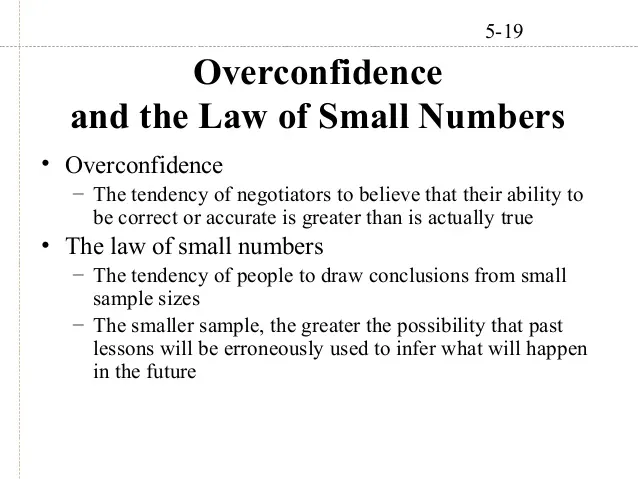
This is why it is wrong to apply the results of a small sample size to a large population. This phenomenon is known as the law of small numbers.
Noted psychologist Daniel Kahneman says that extreme outcomes are more likely to occur in a small sample size than a large one. He adds that you cannot form a theory or explanation based on a random event. A large collection of random events, however, might follow a pattern and interferences can be drawn from the same.

The Law of Small Numbers in Everyday Life
Investing is an area where the fallacy of small numbers is rampant. If you come across a fund manager, whose performance in the past three years has been consistently good, you are likely to trust him and conclude that he is better than most of his peers.
However, if he has been in the business for 20 years, a three-year average is too small a sample to base your opinion on. You ought to consider his long-term track record before deciding if he is the right person to entrust your money with.
Similarly, in a poker game, an amateur player might win a few times purely based on luck. In the long run, however, their luck will run out and players who are highly skilled will come out on top.
Michael Lewis, who is the author of Moneyball (which turned out to be an amazing movie unlike The Force Awakens, Thor III, Captain America I, 22 Jumpstreet, and Iron Man II), says that in a best-of-five series, the best team in baseball will lose to the worst team nearly 15% of the time.
Avoiding the Fallacy of Small Numbers
The bottom line is that a small sample size is likely to have more statistical fluctuations and should not be used to form theories on.
The right approach is to take into account a large sample size, which is representative of the population, over a long period of time, and then form your opinions, theories, explanations, and predictions based on it. It can lower the possibility of erroneous outcomes in your life and help you make informed decisions that are not based on logical fallacies and biases.