
If you think the Black Swan by Nassim Taleb was complex, try interpreting Taleb’s equally important masterpiece, titled ‘Antifragile: Things That Gain From Disorder’.
Nassim Nicholas Taleb created a flutter in the intellectual world with his seminal work Black Swan. The book makes you think and question the values and suppositions by which you live your life.
However, Taleb’s Antifragile makes you introspect even more. Chances are that your mind will be overwhelmed with a triad of: FRAGILE – ROBUST – ANTIFRAGILE.
Each of these represents a concept or a categorization developed by Taleb. None of them hold relevance in classroom curriculums or management programs. To understand what Taleb is talking about, consider the Hydra – the Greek mythological creature with many heads.
Even when one of the heads is cut off, two grow back. If you apply Taleb’s concept, the Hydra has achieved true antifragility, which is the ability to profit from the worst situations and stay relevant in the future, and have better chances to survive and flourish.
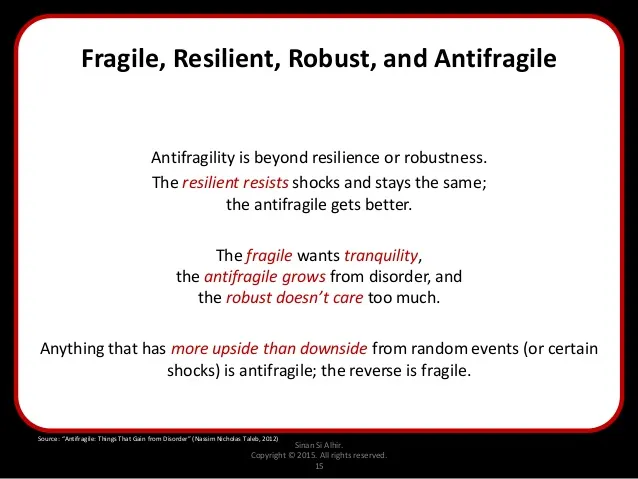
What does Antifragile Mean?
Nassim Taleb tries to categorize all the things that make up our world, including lifestyle choices and institutions, into these three categories – the antifragile, robust, and fragile. Obviously, fragile refers to the worst of these three options, a state in which we shouldn’t exist. Being robust is like the midway point and the state of antifragility is what we should try to achieve.
The fragile: For Taleb, the fragile are highly likely to be stuck with failure because they avoid disruption of any type. Those who cannot adapt to disorders are bound to fail. This fear might be purely due to a psychological barrier or the lack of resources to observe and learn when things go bad.
Such business models or people are hesitant about owning up to mistakes or gathering corrective data to improve future performance. The concept of antifragile says that people and business that like to play it safe all the time are most likely to utterly fail in the future. By being overprotective, such entities make themselves more vulnerable.
The robust: A better way to manage a business or lifestyle is to be robust. This means the ability to stand-up to disruptions. Yes, things that are different from the routine might make you flinch, but by being robust, you are ready to accept such challenges.
You acknowledge the reality that disruptions will always arise. You might not make wholesome changes to the way you live or conduct business due to these disturbances, but you are not distraught about the situation. However, while robustness sounds good, the best way to manage anything in life is to be antifragile.
The Antifragile: This is essentially about embracing disruptions, understanding that shocks can be a stepping stone to introspect, reform, and improve. Being antifragile helps you stay stronger and highly productive even during the most challenging periods.
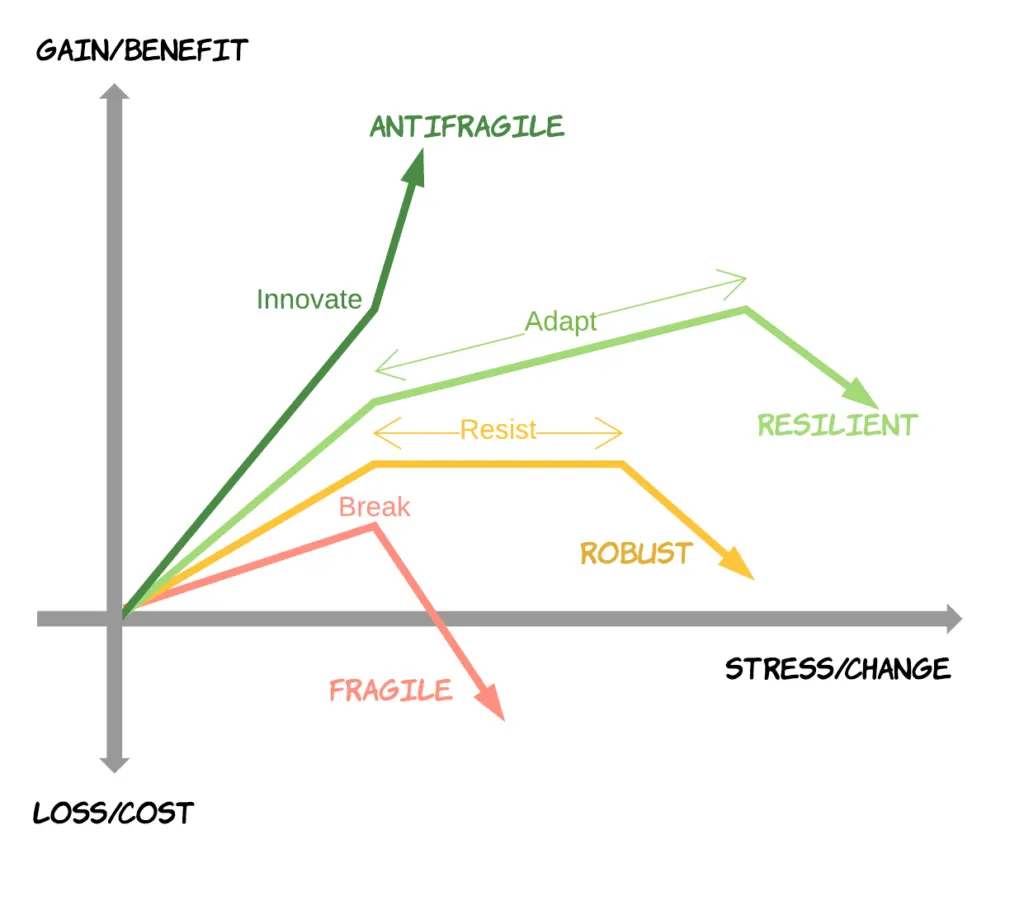
Decoding the Antifragile
Manmade systems can be harmful. Many of them patronize the runaway psychology. People find comfort in more predictability and less changes.
Consider this example – despite the world getting highly technological, technology itself is a huge problem for some individuals and institutions in the beginning. For instance, at present, many have a problem with artificial intelligence and driverless cars. This paradox suggests that unpredictability drives fear.
The idea of antifragility is about not ignoring the unforeseen challenges. It says that even if you fear these future challenges and react to them, it shouldn’t make you blind to the potential opportunities that lie ahead.
An organization that is apprehensive about machine learning and artificial intelligence must not ignore its extraordinary potential to change humanity for the better. The fragile are too worried about the most visible difficulties, and the robust stand their ground without flinching, but the antifragile use every disruption as an opportunity to get better!
Consider the domain of books and authors (Tom Clancy, Taylor Caldwell). The antifragile author will not be deterred by negative reviews. Criticism for a book means that someone took the time to read and review the book—this means a definite audience. The review, no matter how resentful, will further engage more members from the reading fraternity.
At least a fraction of the negative reviews will have some hints about what the readers were really expecting. This data, despite being disparaging, provides an insight into the reader’s preferences and expectations.
Making a note of these observations means the antifragile author will have a checklist of what not to do when penning his or her next title and hopefully it is more useful and has more substance than something like Twilight but that is not saying much!