
Gresham’s Law is essentially a monetary observation of how people tend to use currency when both, old and new currency is in circulation. To some extent, it is still applicable to modern economic situations.
History of Gresham’s Law – a Case of Good and Bad Shillings
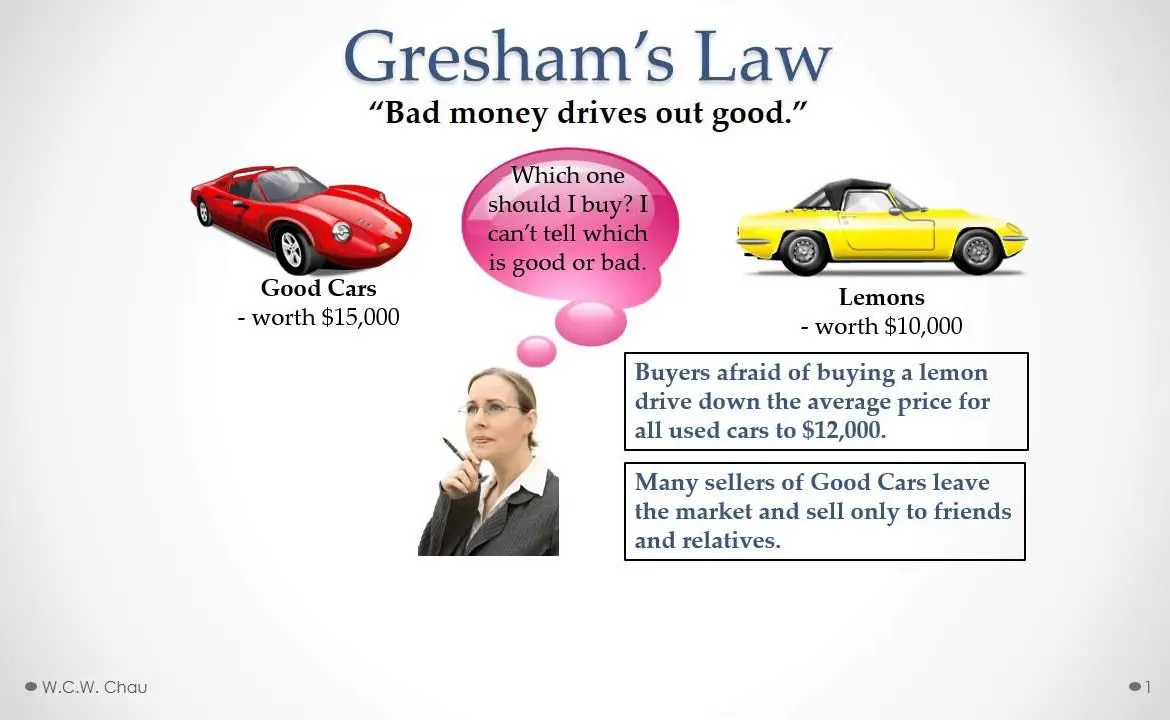
The easiest way to describe Gresham’s Law is to say that “bad” money tends to drive away “good” money. However, the good and bad in currency can be confusing.
This principle originated during a time in history when currency was circulated in the form of coins. Sir Thomas Gresham was one of the more noted financial advisers to Queen Elizabeth I. During his tenure, he found something interesting about the English shilling.
New and old coins were given the same face value to ensure that transactions using either type of shilling were completed without confusion. Despite this, people were steadily losing faith in the newly issued, underweight coins. These were not inferior, but lighter coins that had a lesser concentration of precious/semi-precious metals.
These two monetary units had the same face value, but newly issued coins did not get mass acceptance/usage. Thomas Gresham concluded that when two types of coins are simultaneously in circulation, older [bad] coinage tends to push-out the good [new] coinage.
The law says that when the old and new currency is in circulation, unexpected patterns emerge with people preferring to use older currency. To understand this better, you need to know that nominal value of a coin is also called its face value.
The commodity value of a coin refers to the value of precious metals within the coin. In older coins, the commodity value could exceed the face value.
Modern Interpretation of Gresham’s Law
Today, coinage-related issues are no longer as serious but there are some practical situations where this concept is still seen. This is about Gresham’s Law and the human society, its behavioral patterns, and the most common commercial/trade practices that are an intrinsic part of our lives.
Real-life situations where Gresham’s Law is seen include some types of business environments. Consider a case of two pharmaceutical salespeople trying to push their inventory.
While one sales representative has no qualms about bribing the doctors, the other has a higher sense of moral values and chooses not to indulge in corrupt practices. However, the pharmaceutical and healthcare industry is complex. It functions in such ways that some wrong practices may not be held morally or legally accountable.
Here, this type of bribery is often regarded as an acceptable norm by some people and institutions. In this particular example, the bad practice has more chances of survival, more propensity to bring about the wanted outcomes as compared to the morally correct option. Some people might call it a rather twisted application of Gresham’s Law but the fact it that it happens all the time, all around us!
Also, consider the case of lending habits in the area of sub-prime mortgage during the economic crisis of 2008 (Alan Greenspan was mainly behind this). Here, key decision-makers in reputed banking organizations were driven by fierce competition to engage borrowers.
Those were really tough times and to survive, some institutions allowed their traditional standards to be lowered. But this was for the cause of boosting customer inflow for a short time to survive. The need for survivability led to the ‘bad’ pushing out the ‘good’, and almost all lenders followed the ‘bad’. The ultimate results were catastrophic.
Gresham’s Law and Monetary Economics
Lawmakers randomly fix the price of one currency in terms of another currency. This is often done when trying to establish currency exchange rates.
One, contemporary example is that of the Chinese currency. When China artificially lowers its currency value to achieve export competitiveness (bad practice), other countries in Asia are forced to follow the same practice for survival. The ‘bad’ pushes out the ‘good’ which could mean that China intitiates bad behavior for their own benefit which does not paint a rosy pictures around them though this is another topic.