
The Lindy Effect gained its named from a deli in New York, named LINDY’S. The idea was proposed by Albert Goldman. A standout author, he explained how the Lindy Effect has relevance in many real-life situations.
The same was later popularized by intellectuals and influencers like Nassim Taleb who detailed the theory in Antifragile—his 2012 book that has won rave reviews and continues to arouse a lot of curiosity.
The idea has been recreated, argued with and repeatedly explained by many physicists, mathematicians, and thinkers. The explanations continue, and so does the charm of this interesting concept.
What is the Lindy Effect?
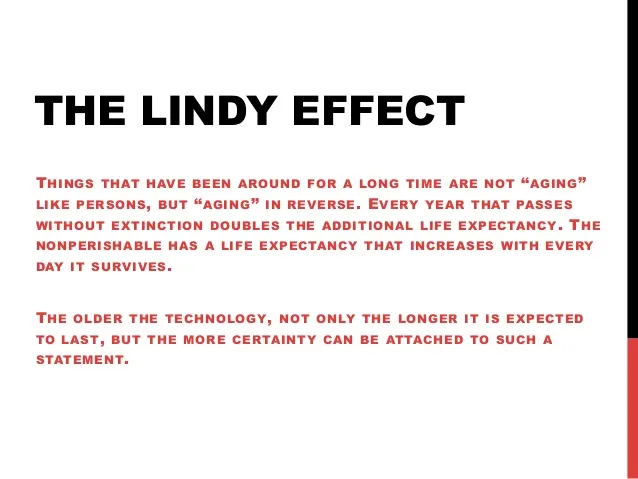
The Lindy Effect is just an idea. It has not been translated into a product or service or technology you can download or buy. The theory puts a twist on the life cycle of things that are non-perishable, such as a business, a brand or an industrial manufacturing approach.
Unlike a person, a business is not perishable. It ages in a different way. It does not develop wrinkles or heart problems as it steps towards its 100th birthday. Now, add the Lindy Effect to this.
This idea says that while a person approaching their 100th year has progressively lesser chances of surviving, a business that has completed a 100 years is more likely to carry on for another 100 years.
The existence of a business for a long period adds to its life expectancy, but for a human being, it increases the likelihood of mortality. This inverse relationship is at the core of the Lindy Effect!
Digging Deeper
Applying the Lindy Effect to a popular novel would mean that if the title has been in print for 30 years, it is more likely to stay in circulation for another 30 years or even more. The same cannot be said for a grocery item that is perishable. This is a type of reverse aging theory. Some thinkers opine that the Lindy Effect is also an indicator of resilience.
While a fruit or vegetable that has survived a week on the dining table is least likely to carry on for another week without rotting, a popular brand that has survived the competition and managed to stay alive for 25 years is more likely to complete another 25 years. The brand has more resilience as compared to the food items. This is why the Lindy Effect is also referred to as a theory of survivability.
This applies to technologies that are again, non-perishable. A trending cyber technology that has been around for only 5 years is less likely to survive the next 10 years as compared to a more conventional technology that has lasted for several decades or longer, such as electricity.
Some more examples:
- Consider the music of Bruce Springsteen. As compared to a more recent artist like Ed Sheeran, music albums by Springsteen are more likely to be as popular 20 years from now. This is because Springsteen’s work has been around for a much longer period. This means more chances of survival in the future.
- Look at the Moby Dick comparison with Twilight. For believers of the Lindy Effect, Twilight will be read for another decade, but if it comes to betting on which book will be read a hundred years from today, Moby Dick presents a stronger case (along with Taylor Caldwell who wrote Dear and Glorious Physician which is a masterpiece – Why the West Rules is pretty amazing too!).
- Try comparing WhatsApp with the Coca-Cola The latter was founded more than a century ago. Today, messaging via WhatsApp seems as common as drinking Coke, but 100 years from today, Coca-Cola is more likely to survive than WhatsApp. Why? Because the aerated beverage has been a part of popular culture for a much longer time – just look at peoples’ physique and that is not a surprise!
Concluding Thoughts
It is important to understand how aging and perishability are related to things that really don’t deteriorate with time or suffer wear and tear. Mortals and animals have a similarity in terms of how their life expectancy is estimated, but the same does not apply to brand names, institutions, reputations, or political ideas.