
Evolution is all about change. Having started as unicellular organisms, we have now evolved into the most intelligent species on the planet (Harry Solomon in Third Rock From The Sun was an alien – remember that!).
The process of evolution itself is highly complex and unpredictable to a certain extent. What starts as a basic trait or feature in an organism could evolve into something entirely different and serve a new purpose. This particular process is referred to as exaptation.
What Is It?
Exaptation is a concept in evolutionary biology which refers to the process in which an existing trait or feature changes its nature and function to serve a new purpose. The concept was proposed by the duo of Stephen Gould and Elisabeth Vrba back in 1982 to explain the fact that the current nature and function of a trait or feature could be entirely different from its historical origin.
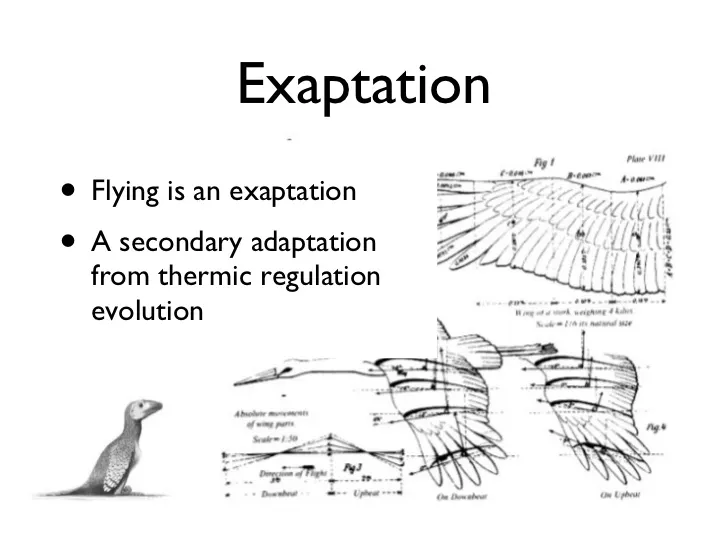
The most commonly cited example of exaptation is bird feathers. Experts say that the ancestors of modern birds had feathers, but were not able to fly.
In that time, birds used their feathers only to keep themselves warm and to attract potential mates. Over a long period of time, however, the function of feathers changed significantly and evolved into movable organs that allowed birds to fly.
Similarly, the limbs of land-dwelling animals initially evolved for the purpose of navigating water, since all life began in the oceans. As sea-dwelling animals started living in land, the bone structure and musculature of these limbs evolved further to make it possible for animals to walk on land.
Exaptation in a Larger Context
The process of exaptation is not limited to evolutionary biology alone. It can be applied to linguistics (how languages evolve over a period of time), brain function (how our cognitive abilities have improved over time), technology (technologies intended for a specific purpose end up serving different purposes at different settings), and so on.
Take for example a laser, which initially was not thought of as a technology with a commercial application. In fact, it was referred to as a ‘solution without a problem’ by experts, as it was literally developed for the specific purpose of proving a theoretical concept.
Today, laser has an extremely wide range of applications – right from cutting, drilling, and welding to holography, telecommunications, microsurgery, and many more (and for entertainment, just watch Star Trek Beyond!).
Magnetron is another technology whose current applications are different from what it was originally intended for. It was initially used in radar systems during World War II. Today, the technology is primarily used in microwave ovens.
The Future of Exaptation
Researchers say that exaptation is not an outdated concept, but can actually happen even today under the right circumstances. They say that if an organism is forced to live off of food sources that it has never consumed before, it might be able to change its metabolism to digest and derive energy off the new food source.
While we still have a long way to go in terms of figuring out how human bodies could evolve in the future, the concept of exaptation certainly is a good starting point for our experimental thoughts.
The concept serves a similar purpose in our everyday life as well. Successful businessmen and entrepreneurs say that a new idea or technology might not always succeed right away, even if it is good or useful. It should not, however, stop you from experimenting with it.
The technology could eventually be linked with an existing technology or could be used for a completely different purpose than what it was intended for. It is the very basis of innovation. So, there is absolutely no doubt that exaptation as a concept or mental model can be an extremely useful tool in your arsenal.