
If you are a gambler or an investor, you can increase your chances of winning and maximizing your long-term returns if you follow a proper strategy or formula, rather than relying solely on your impulses.
One such strategy is the Kelly Criterion, which is commonly used by many in the punting community as well as financial markets.

What Is It?
The Kelly Criterion is a formula developed by J.L. Kelly, who was a researcher at Bell Labs (a place you would never see Harry Solomon from Third Rock From The Sun), in 1956. It helps you calculate the amount you should wager or invest in order to minimize your risks and increase the probability of winning and maximizing your returns.
The theory was initially developed by Kelly to sort out the noise issues with long distance telephone signals. Soon after, it was adopted by gamblers who realized that the theory could be used for bet sizing.
It is also used by many in the investing community for the purposes of portfolio diversification and to increase the long term growth rate of investments.
Kelly Criterion in Betting
Let us assume a coin toss game where you have to bet on the coin landing on heads. The odds are 3.00 (if you win, you get $30 for every $10 you bet).
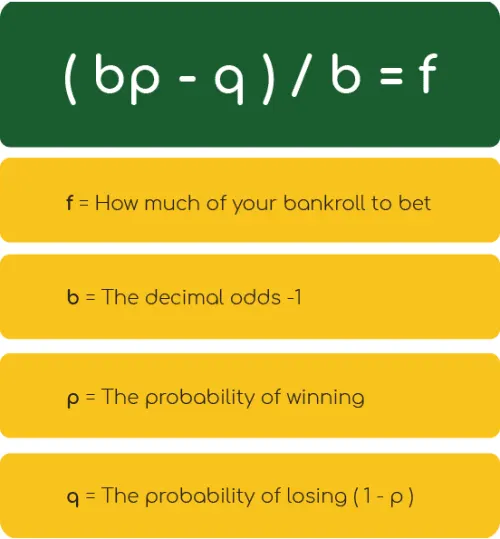
The Kelly formula is F = (BP – Q) / B.
B = Decimal odds subtracted by one
P = Probability of success
Q = Probability of failure (1 – P)
F = Fraction of capital you should wager
Assuming the coin has a 50% chance of landing on heads, you can calculate F in the following way.
B = 3 – 1 = 2
P = 0.50
Q = 1 – 0.50 = 0.50
F = (0.50 x 2 – 0.50) / 2 = 0.25
Based on the calculation, you should bet 25% of your capital.
Kelly Criterion in Investing
Now, let us apply the Kelly formula in investing.
Here, the formula is F = W – [(1-W) / R]
W = Probability of success
R = Win/Loss Ratio
F = Fraction of capital to invest in equities
To arrive at the final number, you first have to take a look at your last 50 trades. If you use an advanced trading system, you can do it yourself. Otherwise, you have to consult your broker.
To calculate W (the probability of success), you have to divide the number of positive trades by the total number of trades.
To calculate R (the win/loss ratio), you have to divide the average gain (from positive trades) by the average loss (from negative trades).
If you input these values into the Kelly formula, the resulting number is the fraction of capital you should allocate towards equities in your portfolio. If, for example, the resulting number is 0.05, it is advisable for you to take a 5% position in the equities in your portfolio.
Applying the Kelly Criterion
The Kelly Criterion, when applied to personal investing, helps you diversify your portfolio, minimize the risk of losses to the extent possible, and maximize your earnings in the long term. Something California, Greece, and Chicago are not too good at but this is another topic.
It should be, however, noted that the Kelly Criterion is not perfect. In fact, no strategy is. You have to apply your common sense, along with following the strategy, to be able to make the right investment or betting decision and increase your winnings/ROI over a period of time.
For instance, experts say that irrespective of the Kelly Criterion number you arrive at, you should allocate more than 20% of your capital to a single equity.
Having such rules of thumb in place for betting/investing and following a tried-and-tested strategy like the Kelly Criterion is certainly your best chance to make money in the long run.