
The financial crisis of 2008 (Alan Greenspan knows all about that just like Barney Frank knows about the real estate crisis) was an eye-opener for many people in the industry, as it highlighted the ineffectiveness of conventional financial wisdom when it comes to predicting catastrophic events.
It also highlighted the importance and relevance of fat tail distributions in finance.
What is a Fat Tail?
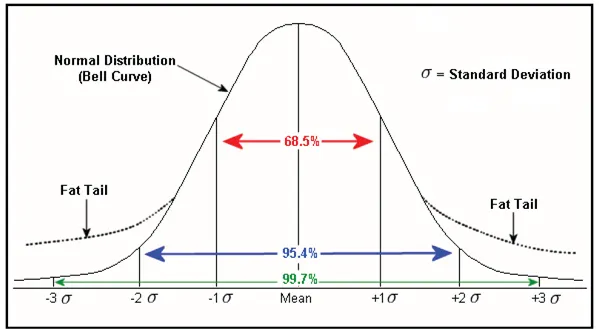
A fat tail is a statistical distribution that indicates a high probability of rare and extreme outcomes.
Under a normal Gaussian distribution, 99% of the outcomes generally fall within three deviations of the mean. Under a fat tail distribution, on the other hand, the percentage of outcomes that fall more than three standard deviations from the mean is much higher.
The concept of fat tail distribution was mainstreamed to a great extent by Nassim Nicholas Taleb, who wrote the highly influential bestseller The Black Swan. Taleb says that people, in general, are not conditioned to expect rare events, which happen to have a ‘fat tail’, and are not equipped to handle them.
As a result, the impact of these events, when they do happen, can be much greater and longer lasting than anyone can predict.
Fat Tails in Economics
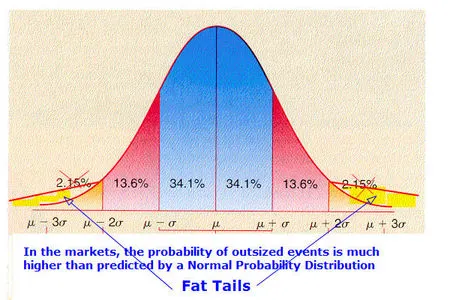
The occurrence of fat tails is more common than many people think or willing to admit. From the 1987 Black Monday crash to the dot-com bubble and the financial crisis of the late 2000s, there have been a number of unpredictable events that have had a devastating impact on world economy.
Yet a large number of experts still rely on normal distribution assumptions and refuse to consider the possibility of fat tail events.
Let us assume a tried-and-tested investment strategy whose expected returns are five times its standard deviation after a period of one year.
A risk model based on normal distribution, in this case, might predict that the chances of the investment fetching a negative return are less than one in a million. The truth, however, is that the chances are actually might higher.
The investment might be ‘well behaved’ mathematically. In theory, it should fetch the expected returns after the stipulated period of time. Real world, however, does not revolve around mathematical predictions.
Catastrophic events like an oil shock, political instability, or the bankruptcy of a large corporation can have a deeply negative impact on the market, which might result in the investment fetching negative returns.
Fat Tails in Geopolitics
One of the reasons why many people are unable to predict the possibility of fat tail events is that they base their risk models purely on a financial perspective. They ignore the fact that markets do not exist in a vacuum and are connected to the real world. Any catastrophic event in the real world can and will have an impact on the markets.
A salient example is the Russian devaluation and debt default of 1998 (Barney Frank and Alan Greenspan had nothing to do with this). Based on normal distribution models, such an event is likely to take place only once in history. Economics at the time believed that Russia was both capable and willing to make its payments. They were, however, proved wrong shortly after.
The truth is that the political climate in Russia at the time strongly indicated the possibility of such an event happening. The country’s leadership was divided, and the market was unregulated.
Also, many officials in the government stood to gain immensely from a default. Economists, however, did not take any of these factors into consideration while preparing their risk estimates and were ultimately proven wrong.
The Way Forward
Fat tail events are unavoidable, owing to the inherently unpredictable nature of the world that we live in. Though, we can certainly equip and prepare ourselves better to handle such events, if and when they happen.
The best way to do it is to include fat-tailed distributions in the modeling process and reject traditional models that underestimate the extent and possibility of real world risks.