
The long tail is a business model which involves offering a large number of niche products that are low in demand and have a low sales volume. This is in stark contrast from traditional business models, which focus more on a small number of best selling products with a large market share.
The term was coined and popularized by Chris Anderson, who made an argument for long tail based business models and marketing strategies in his book ‘The Long Tail: Why the Future of Business is Selling More for Less’.
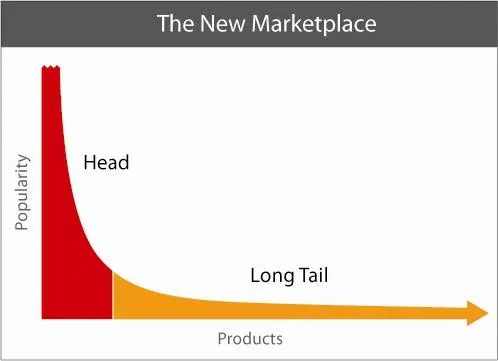
In his book, Anderson says that we are witnessing the transition from a marketplace that focuses on best selling products to one that focuses on a million different niche products.
The Strategy of Selling More for Less
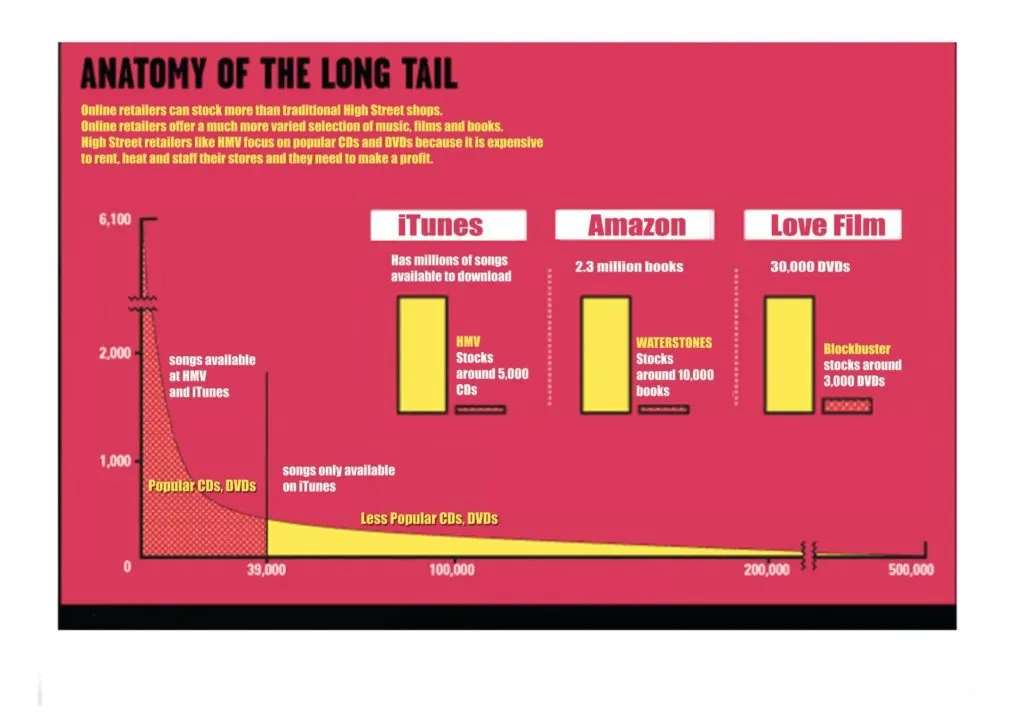
Anderson says that over a period of time, the market share of a large number of niche products, which are low in demand and have a low sales volume, could equal or even exceed the market share of a small number of bestselling products. He cites two reasons for this phenomenon.
Firstly, customers no longer rely solely on mainstream markets for their needs. The proliferation of online stores has opened up the marketplace completely, and customers now have more choices than they ever had before at any point in time.
Secondly, the internet has made it possible for micro and small business owners to carve their own niche in the market rather than taking on the big businesses head on. It has also reduced the cost of storing, cataloging, and selling products drastically, so people can afford to make very few sales a month and still make profits.
Bestsellers vs. Low Volume Sellers
Anderson argues that while mainstream products sell more due to the availability of a large distribution network and endless amounts of shelf space, their production, marketing, and distribution costs are high, which reduces the profit margin significantly.
Niche products, on the other hand, tend to remain in the market for a long period of time due to their low demand and are often sold through off-market channels. Their production, marketing, and distribution costs are extremely low, which makes them profitable in the long run.
In his book, Anderson makes the case for a long tail economy and states that the American consumer base is currently undergoing a paradigm shift – drifting away from mass-market buying and towards niche buying. With tax cuts and all those jobs, there is certainly more buying.
Applications of Long Tail Theory in 21st Century Marketplace
Perhaps the best example of a long tail business model in the 21st century is Google. Google was perhaps the first company to realize that niche players from various industries needed advertising services just as much as large corporations and offered a medium for the same.
Google has benefited immensely from long tail customers who might not contribute much towards the search engine company’s revenue individually but collectively account for a significant percentage of the overall revenue.
In fact, Eric Schmidt, the CEO of Google, noted in a 2005 interview that he was surprised as to just how long the ‘long tail’ is. He said that a surprisingly large number of businesses, which could not benefit from traditional advertising mediums, had in fact benefited from services like AdWords and AdSense.
The message to the modern day business owner or service provider is quite simple. Rather than trying to create that one bestselling product (such as a House of Cards, 24, The Good Wife, and Bosch) that could appeal to a large customer base, try creating niche products that fulfill the needs of a number of small but select customer bases.
You can use the internet to expand your niche marketing capabilities to the fullest extent possible and benefit from the long tail shifts happening in your industry.