
It is said that change is the only constant in life. The principle applies not just to individuals, but large organizations as well.
Any large organization ought to be able to unlearn outdated things, learn new things, change its assumptions and projections from time to time based on data, and constantly adapt to an ever-changing environment. This is where the single and double loop learning concepts enter the picture.
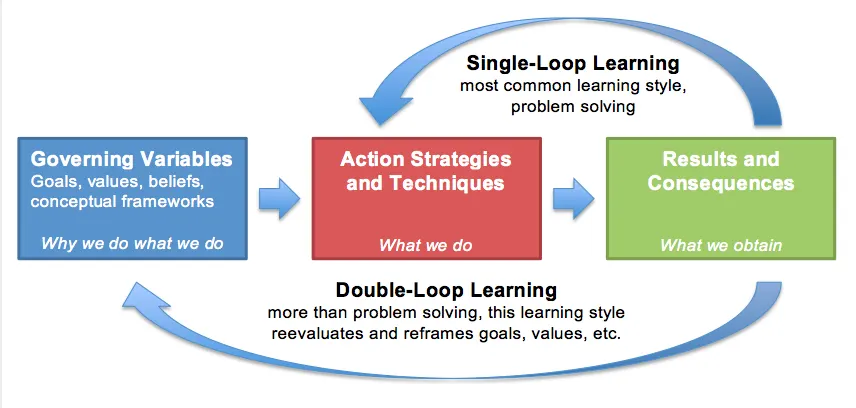
Single and Double Loop Learning
The concept of single and double loop learning was developed by the duo of Chris Argyris, who was a psychologist, and Donald Schon, who was a philosopher. The concept deals with organizational learning – how people in large organizations identify, react to, and rectify problems and deal with changes.
Single Loop Learning
In a single loop learning process, people observe the difference between what is expected (goals) and what is actually achieved (outcomes), analyze how the situation could be improved and problems could be rectified, and then modify their behavior and actions accordingly.
Let us say a company launches a product, which it claims could be a game-changer. The product, however, is not received well by the target customer base. The company thinks that the problems could be fixed at the production level and the marketing level, by motivating the employees to work harder and by marketing the product better.
This, in essence, is single loop learning. When a goal is not reached, people think of possible reasons as to why they failed and then try to fix the problems by working harder or by changing their working methods altogether.
Double Loop Learning
In a double loop learning process, people observe the difference between what is expected (goals) and what is actually achieved (outcomes), try to determine the root cause of the problems, and correct them at a fundamental level.
In the aforementioned example, a company tries to fix the problems at a lower level in order to make its product a success.
If the product is still not received well, the company should ideally try to find out if such a product is even necessary for their target customer base. Maybe the problem is not at the production level or marketing level, but at the very core of the initiative itself.
If your target customer base does not need or want a particular product, it will remain a failure no matter how hard your work at it and market it.
In other words, rather than trying to fix the symptoms, you should try and fix the root cause and withdraw the product from the market.
Once you do, you can fix its flaws at the design and manufacturing level and re-launch the improved version, or you can come up with a new product altogether – one which appeals to your target customer base.
Difference between Single and Double Loop Learning
The most notable difference between single and double loop learning is that the former is all about cosmetic changes while the latter is about fundamental changes.
In other words, if an organization is able to continue with its objectives, policies, and framework even after detecting and correcting the problems, it is the result of single loop learning. If an organization is forced to change its objectives, policies, and framework after detecting and correcting the problems, it is the result of double loop learning.
Applying Single and Double Loop Learning in Life
The idea is to be fluid and adaptive so that you do not rely on a rigid framework, which cannot be questioned or changed no matter what happens.
When things go wrong, you should be able to think beyond cosmetic changes, identify the problems with the underlying norms and policies, and change them at a fundamental level to be able to achieve your objectives.