
The map is not the territory is a concept developed by noted mathematician Alfred Korzybski. Korzybski developed the concept to explain the fact that belief is different from reality.
In other words, our perception of the world could be different from the real world. While it might sound too obvious, a surprisingly large number of people tend to confuse their beliefs with reality.
The Concept and What It Means
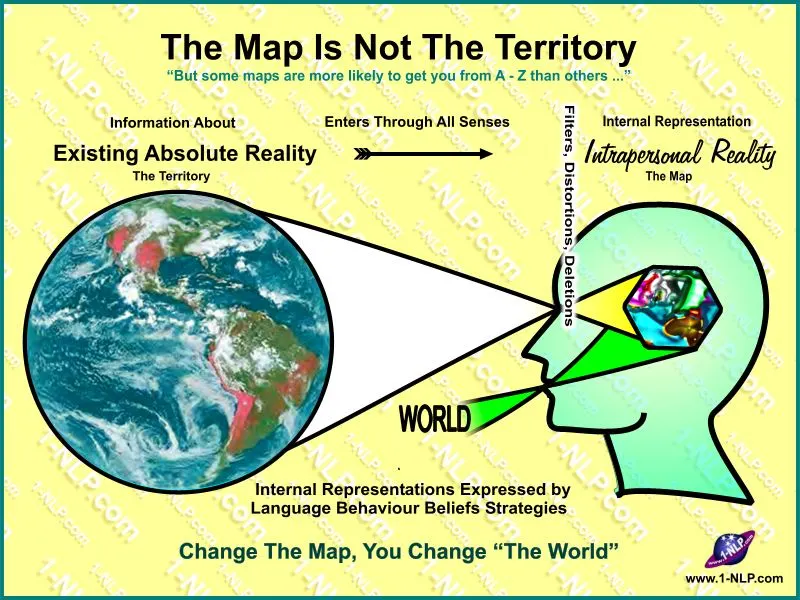
Human beings have the tendency to simplify things and constitute abstractions in an effort to better understand the world that they live in.
We create descriptions of the things around us, which are absolutely necessary, but it is also important to remember that the description of an object is different from the object itself.
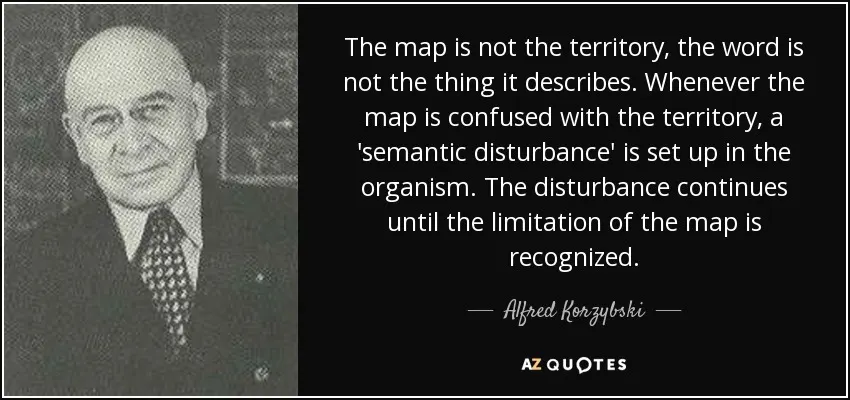
Korzybski came up with the concept of the map is not the territory precisely to drive this point home. The map, he said, is merely a representation of a territory.
It is a simplified version, which omits a number of important details about the territory. While it is certainly needed, it is also equally important to understand that the map is a reduction of reality, not the reality itself.
Why It Matters
People create abstractions and beliefs to make sense of the world they live in. At times, however, they tend to get stuck in their beliefs and perceptions of the world and refuse to see the world for what it is.
Let us say you are walking down the street and come across two people arguing with each other. Based on what you see and hear, you might develop a theory as to what the problem is, what they might be arguing about, and who did what. Let us say a few other people on the street also happen to watch the same thing.
Now, if you ask those people, they might have a different take on the event compared to yours. If you ask the people who were arguing, they might tell you a completely different story. In fact, those two people might tell you different versions of the same event.
The point is that your abstractions and perceptions are at best an imprecise approximation of the real world. If you believe in your own version of the event and convince yourself that it is what happened, you could be entirely erroneous.
There are a couple of key points to be understood with respect to Korzybski’s metaphorical concept.
- The map does not change the territory at any time. Just because you erase a portion of a territory on a map, it does not disappear in the real world. Similarly, when your beliefs and perceptions about the world change, the world does not change consequently. The world is what it is, but your understanding of it might change from time to time.
- Whatever beliefs you hold to be true, they are similar to a map – a representation or abstraction of the real world, not the world itself. A map can only be helpful if you understand its limitations. Similarly, you should always know that your beliefs could change in the future, in light of new information. Look how people view tax cuts now, for instance, with all this job creation.
The Value of Understanding the Difference between the Map and the Territory
Once you fully understand the difference between an abstraction and a real thing, you will be able to accept your views and beliefs for what they are, rather than holding them to be absolute truths.
If you can accept the limitations of your views and beliefs, you can evaluate them and change them as you learn more and grow as a person. It can help you develop better relationships with those around you, create positive life experiences, and improve the quality of your life.