
Order of magnitude (OOM) is a method of numerical representation in which numbers are described in terms of powers of ten.
For example, 3,474,000, which is the diameter of the moon in meters, can be written as 3.474 x 10⁶. Similarly, 0.00000000000000000000000000166, which is the weight of one atomic mass unit in kilograms, can be written as 1.66 x 10⁻²⁷.
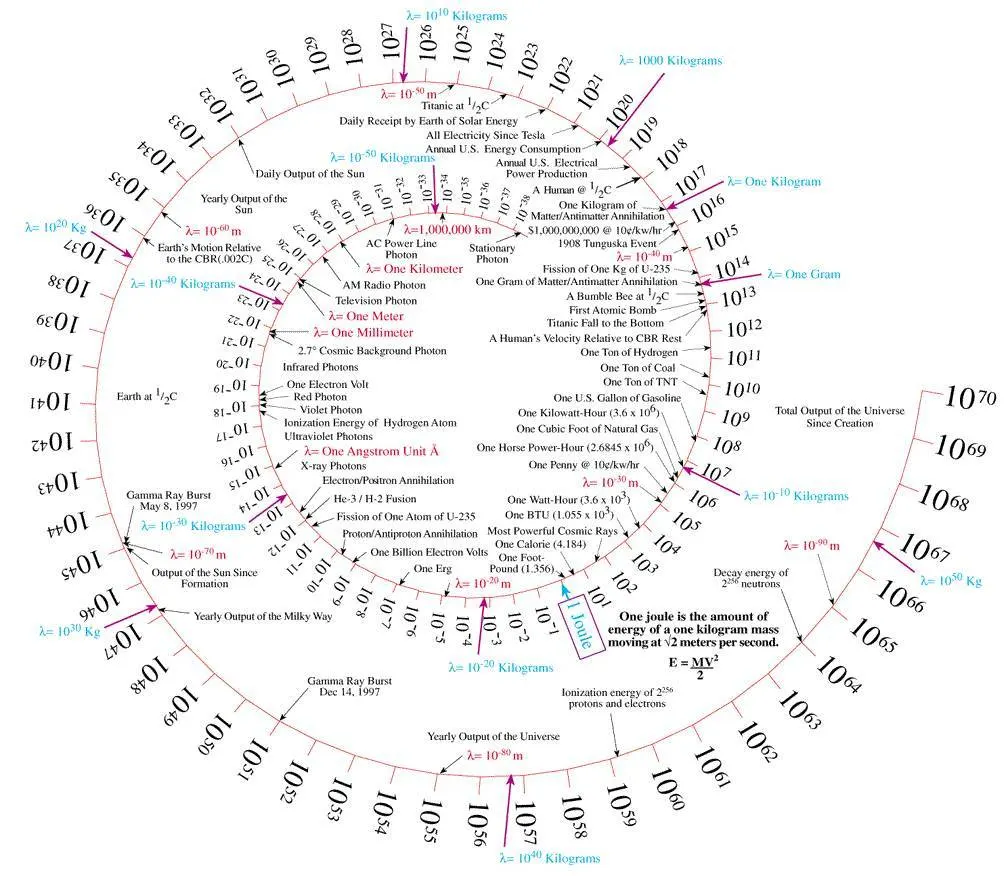
Expressing Numbers in OOM
The OOM of a number is essentially the number of powers of 10 it contains. For example, the core temperature of the sun is 15,600,000 K. The number can be expressed in terms of OOM as 1.56 x 10⁷.
In other words, if the OOM of a number needs to be increased by n times, it needs to be multiplied by 10n. An increase of one OOM means, you multiply the number by 10. An increase of two OOM means, you multiply it by 100, and so on.
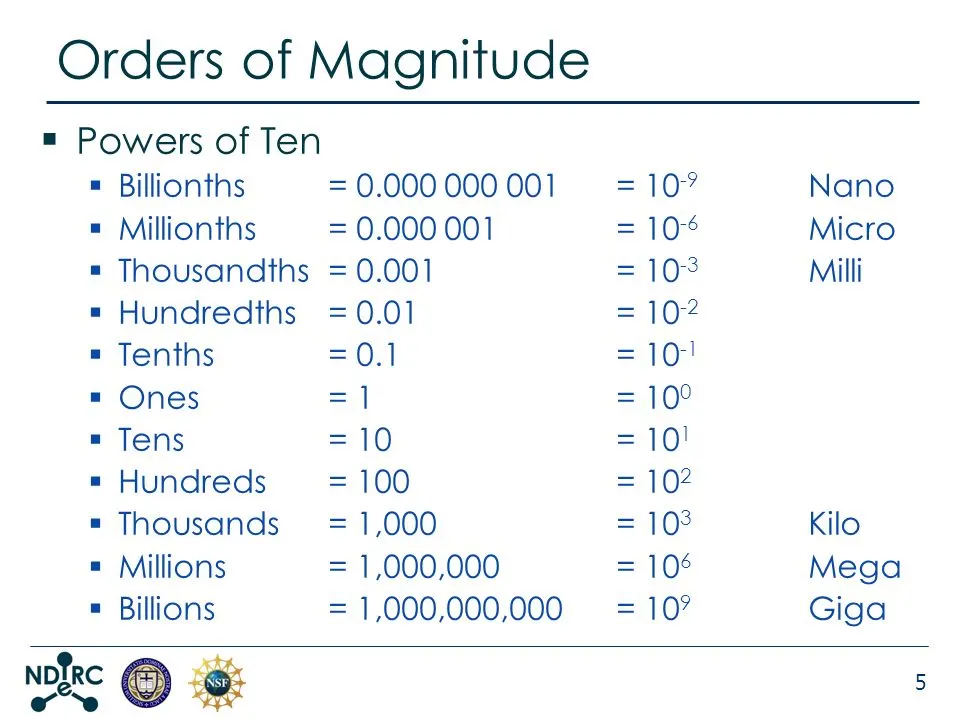
The same law applies to small numbers, but inversely. For example, the mass of the average human cell is 0.0000000001 kg.
The number can be expressed in terms of OOM as 1 x 10-12. In other words, if the OOM of a number needs to be decreased by n times, it needs to be multiplied by 10-n. A decrease of one OOM means, you multiply it by 0.1 or 10-1. A decrease of two OOMs means, you multiply it by 0.01 or 10-2, and so on.
Why is OOM Needed?
Measurement is the very foundation of science. To study, understand, and explain various phenomena in the known universe, scientists and mathematicians observe, measure, and evaluate a wide range of things and arrive at a conclusion.
The problem, however, is that large and small numbers can be difficult to write and use in various calculations.
The earth, for instance, has a total surface area of 169,900,000 square miles. Now, if you were to multiply this number by another large number for some calculation, you would end up with an extremely large number.
Using such large numbers in arithmetic calculations can be a cumbersome process. To avoid this problem, scientists and mathematicians employ a method called ‘scientific notation’, which allows them to express very large numbers in a convenient form.
OOM for Approximations and Comparisons
OOM is also very useful for the purposes of approximation and comparison. Let us consider an engineer, who is involved in a bridge construction project, wants to determine the amount of pressure on the bridge’s supporting beam. Let us assume the measurement is 600,058 units, but the instrument used by the engineer is only precise to ±500.
In such a scenario, the engineer cannot be entirely sure of his measurement, as the last few digits might not be accurate, owing to the instrument’s inbuilt limitations. He can be, however, sure of the accuracy of the first few digits.
Using OOM, he can write it as 6.00 x 10⁵, which conveys the message that he is sure about the first few digits and not sure about the last few.
Similarly, OOM is also used by scientists to determine the relationship between two entities. For example, the distance between the Earth and various stars are often compared in terms of OOM, which not only makes the calculations easier, but it also makes the end results easier for the public to understand. Unlike the tax code which was not simplified enough!