
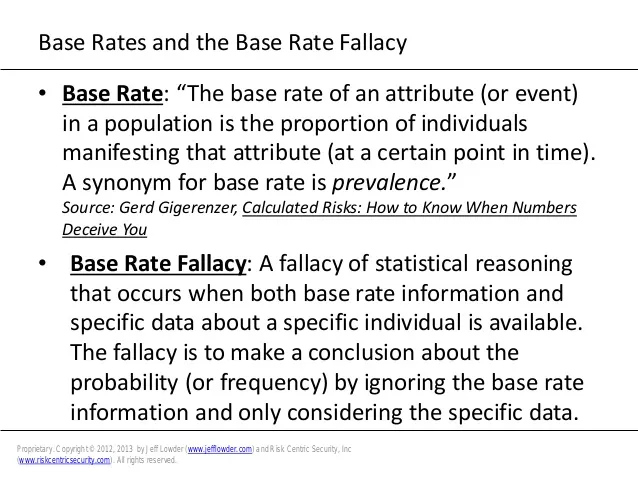
Failure to account for base rate, also referred to as base rate neglect or base rate fallacy, is the habit of jumping to conclusions without factoring in all the relevant, important data.
People often try to determine the likelihood of an event without taking into account the ‘base rate’ – the statistical information that can help them make an informed decision.
Base Rate Fallacy Explained
To be clear, people do not make any decision without considering certain factors or data. The problem, however, is that the data they take into account is not relevant in many cases. As a result, any decision they make is likely to be erroneous.
Let us consider a person named X who is an introvert, organized, and likes to read. Is he a librarian or a physician? If asked this question, most people are likely to assume that X is a librarian, based on the description of his character. The answer, however, is very likely to be wrong.
There are over a million physicians in the United States. The number of librarians, on the other hand, is less than 200,000. In other words, there are more than five physicians for every librarian in the country.
With this being the case, a random person drawn from the total population of physicians and librarians is more likely to be a physician, due to the sheer difference in their numbers.
In fact, if the question is framed differently, people are likely to give a different response.
A random person is drawn from a population of 1.2 million – comprising one million physicians and 200,000 librarians. Is he likely to be a physician or a librarian?
In this scenario, people are likely to say ‘physician’, because they are considering only the base rate – the statistical information – not the character description which could be misleading most of the times.
Using the Right Data to Make Decisions
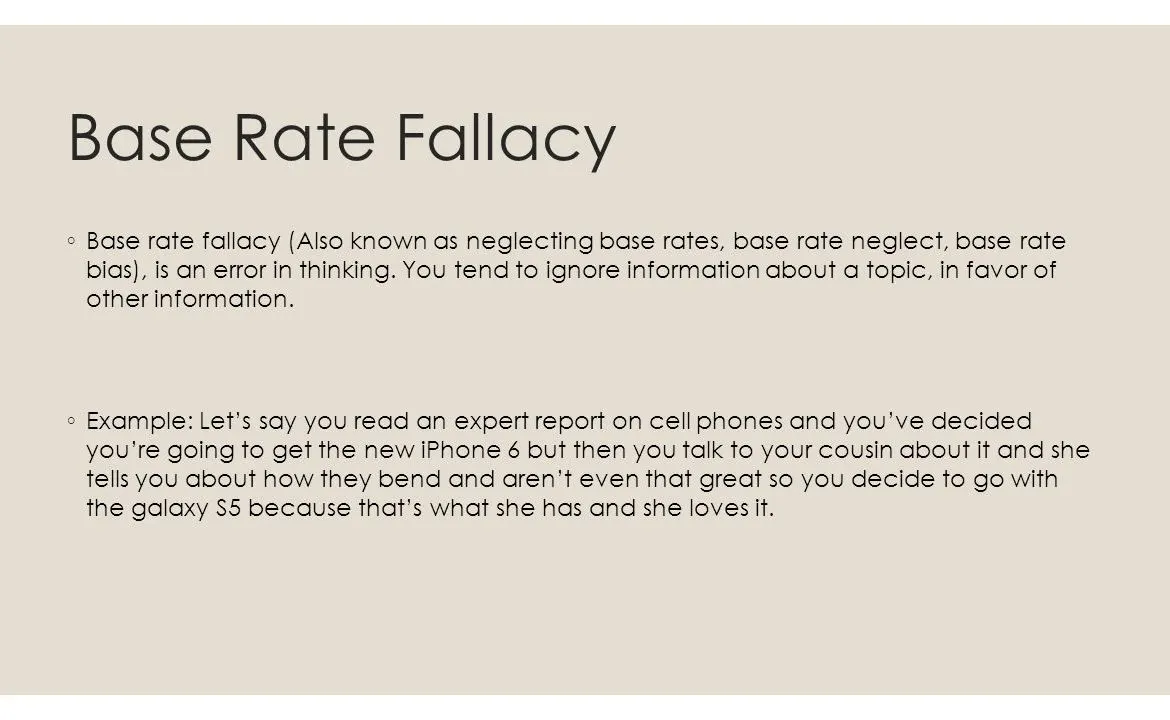
Basically, in the absence of other information, people are likely to consider the base rate and make an informed decision. If they are provided with more information, it is likely to cloud their judgment and they are likely to neglect the base rate.
The fallacy can be witnessed in people’s daily lives. People invest in a company based on a market event or the company’s recent successes, rather than considering more important factors like the company’s financial position, past growth rate, the demand for its products or services in the industry, and the track record of the management team.
Similarly, most people are likely to panic if they test positive for a fatal disease. Now, let us assume the test is accurate 97% of the time.
In other words, it has a 3% false positive rate. In such a scenario, people are likely to assume that there is a 97% chance they have the disease. It is, however, an entirely wrong assumption.
If the disease affects one out of 1,000 people, the likelihood of you being the one out of the 1,000 is astronomically small compared to the likelihood of you being one among the 3% of people who receive a false positive result. In fact, there have been many instances where people who tested positive for a disease were tested again and the results came back negative.
Avoiding Base Rate Fallacy in Everyday Life
So, what is the lesson to be learned here? It might be tempting to make decisions based on the data that is immediately available and/or appeals to your existing beliefs.
Such a decision, however, is not likely to be the right one, as it ignores statistical data, long-term patterns, and other information that has historically been proven accurate.
The bottom line is that you need to be aware of your built-in biases and the penchant to ignore important data when it matters the most.
If you do, you are less likely to make snap judgments about people or things you know little about and more likely to make well informed decisions based on facts, rather than solely relying on your instincts or irrelevant and misleading data.