
Warren Buffett’s, the controversial investor, business partner Charlie Munger once famously said: “All I want to know is where I’m going to die, so I’ll never go there.” That is inverted thinking.
Munger says German mathematician Jacobi’s work inspired him to think like that. Jacobi was known to solve complex problems by follow the mental model of inversion. “Man muss immer umkehren,” he would say. (“Invert, always invert.”).
Munger says that many difficult problems in life are best solved when addressed backward. It is in the nature of things. Ancient philosophers Seneca, Marcus Aurelius, and Epictetus used to perform an exercise where they would consider the “worst case scenario.” It is counterintuitive. It is a thinking strategy here you consider the diametric opposite of what you wish. It is called inversion.
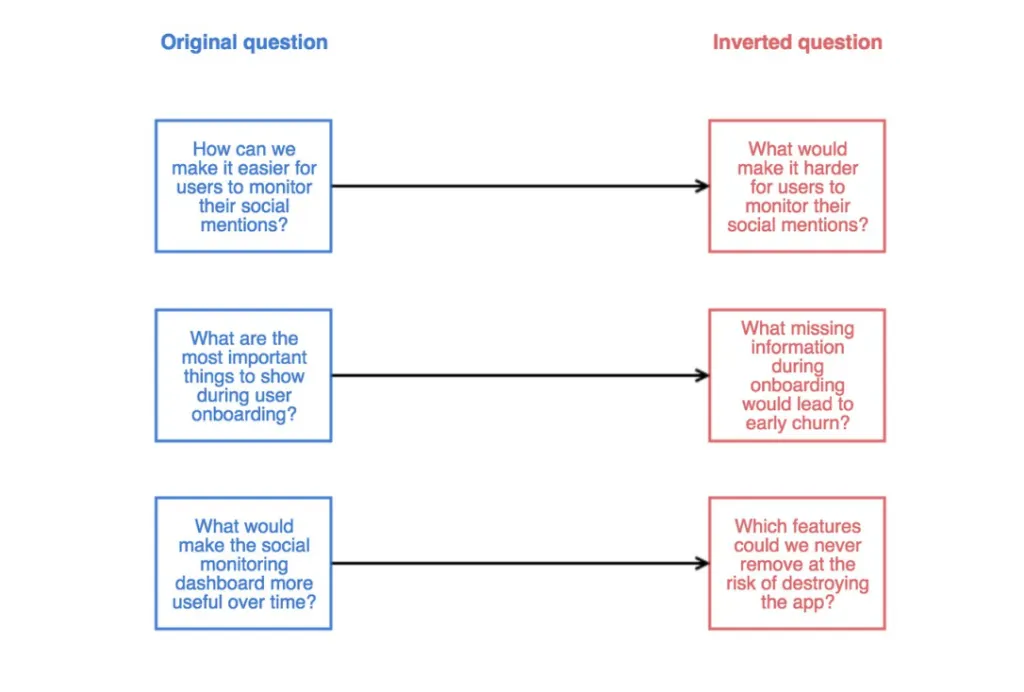
Powerful Thinking Tool
Inversion puts the spotlight on roadblocks and errors that are easy to miss at first sight. What if the opposite is true? What if you focused on the opposite side of a situation? Successful people train themselves to think forward as well as backward. They force themselves to consider the reverse. This approach can sometimes uncover compelling opportunities.
For instance, one of the paradigm shifts in the world of music in the last many decades was triggered by Nirvana, a band that introduced alternative rock. Nirvana turned the rules of mainstream pop and rock totally upside down.
When hair metal bands were pouring in millions to record and promote each album, Nirvana produced Nevermind for $65,000. Nevermind is now a part of the Library of Congress as one of the most “aesthetically, historically, and culturally important” sound recordings of the 20th century.
Practical Use of Inversion Model in Everyday Life
Avoiding mistakes is a little-used way of self-improvement. Even if you are not particularly talented, fast, or smart in a field, you can achieve success in most jobs simply by being reliable and proactive. Sometimes it is more useful to consider why people fail than why they succeed.
Use at the Workplace
A manager or team leader could ask themselves: “What would a terrible manager do in my position?” That will help them avoid those mistakes.
The innovation head in a technology company could ask: “How can we make the company less innovative?” Removing those barriers will help generate more innovation.
A marketing team that wants to win a new client’s business could ask: “What will alienate this customer?” This question could unravel surprising insights into why a customer is lost.
Use in Relationships
What are the typical behaviors that could destroy a marriage? Not respecting the spouse, lack of trust, lack of empathy, focusing excessively on kids instead of investing in relationship with the spouse, not being open about finances, and so on. Inverting a happy marriage would reveal how to avoid a broken one.
Personal Finance
Everyone wants financial security. But what if you asked how you could destroy your financial security? Before you worry over how to make more money, it is important to figure out how to avoid losing money. If you can simply manage to avoid that, you would be far more financially secure than many others who are victims of self-inflicted financial stress.