
The adult human brain weighs about three pounds. There is no biological difference between the brains of two individuals, and yet some people turn out to be great thinkers, inventors, scholars, and entrepreneurs, while most others remain average performers (or below average – see Alan Harper in Two in a Half Men!).
Even in the classroom, the top performing students grasp complex concepts fast, learn and memorize easily, while most others struggle to compete with them academically.
The reality is that the winners of the world have somehow found the formula of learning, comprehending, analyzing and memorizing, and applied it to create extraordinary results.
The Secret Formula of Learning
The secret is that there is no secret. Human beings have had the mind tools available to them from the times when the first man conceived that he could slice the trunk of a tree to invent the wheel, and then put four wheels on the sides of a plank made of bamboos to create a wheel cart to transport people and goods.
The time-tested mind tools available to human beings can be broadly classified into three types:
- Flashcard
- Memory Palace
- Mind Mapping
The key is to use these tools in an integrated manner to achieve the best learning, analysis, and decisions.
Many people question why you need to rely on these mind tools, when you have aids available such as a computer or mobile. Well, that’s how the average human being thinks. But the man who created the computer didn’t have a computer. He used mind tools. Every scientific, philosophical, and spiritual breakthrough that has ever occurred on this planet has only occurred with these mind tools.
Flashcard
Flashcards are physical or virtual cards that are designed to encourage learning in a question-answer format. One side of the card has the question, and its answer is provided overleaf. Used as a learning tool, flashcards will exercise the mind’s active recall process.
The learner reviews the cards repeatedly at intervals to check how far they can recall the answers. The idea is that repetition creates a permanent memory that gets etched on the mind.
Memory Palace
Mere repetition or rote (the flashcard tool) is not enough to complete the learning process. Mind needs associations to remember something permanently. Even if you repeat something a hundred times, you are likely to forget it within a few months or years, if you did not create an association.
President Abraham Lincoln had the unique ability to remember names of people he would meet and he could quote scripture too but this is another subject! He first repeated the name a few times during an introductory conversation with the person. Then he created a mental association of that name with some skill, specialty, peculiarity, or hobby of that person.
He took interest in the person as a whole, and not just repeated the name in his mind. That allowed him to recall that person’s name even if he would meet them many years later.
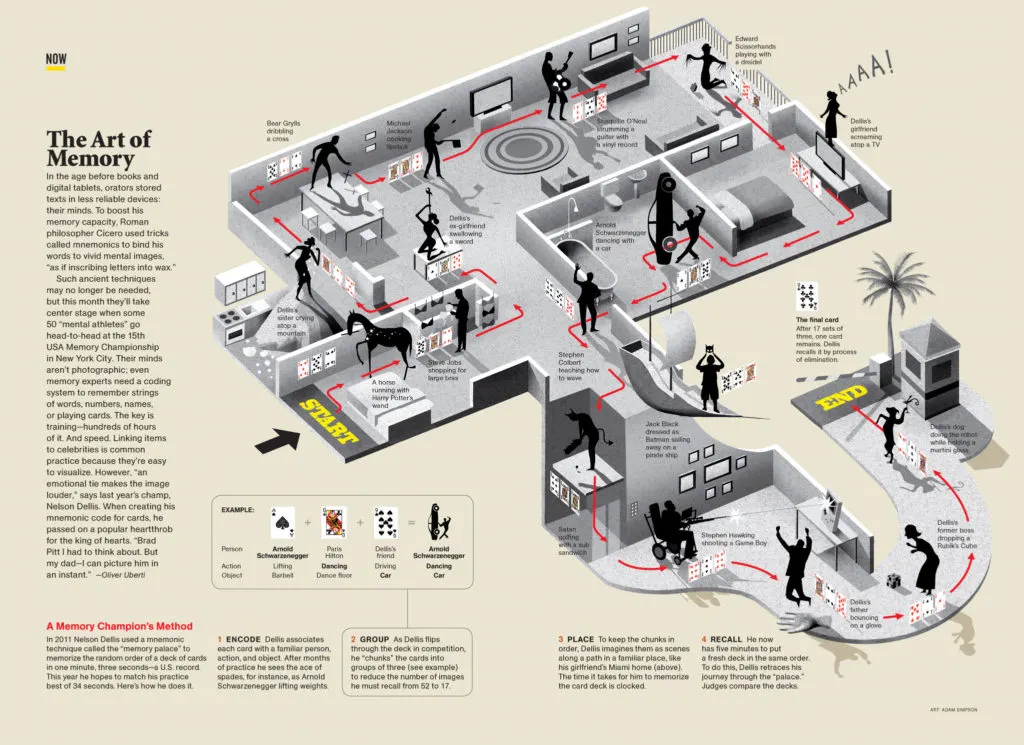
That dimension of learning is called the “Memory Palace”. Any kind of information can be retained in the mind by using memory palaces. Memory palaces involve two key actions: (a) visualizing information in the form of images (b) storing those images in a ‘memory palace’.
Mind Mapping
In real life, information is often complex and multi-layered. Thinking or brainstorming can also produce many different thoughts, ideas, and potential solutions. The amount of mind data that is generated in this way can run into several pages, if it is all put on paper. For most people, there is no clear view of how all of this fits together, and does it produce any meaningful answer.
This is where mind mapping comes in to de-clutter the mind, and make the best use of data absorbed through flashcard and memory palace techniques. Mind mapping allows you to process your thoughts, ideas, and information organically, and enables comprehensive analysis and recall – though trying to figure out the ACA health care could be impossible for anyone though let’s get back on track.
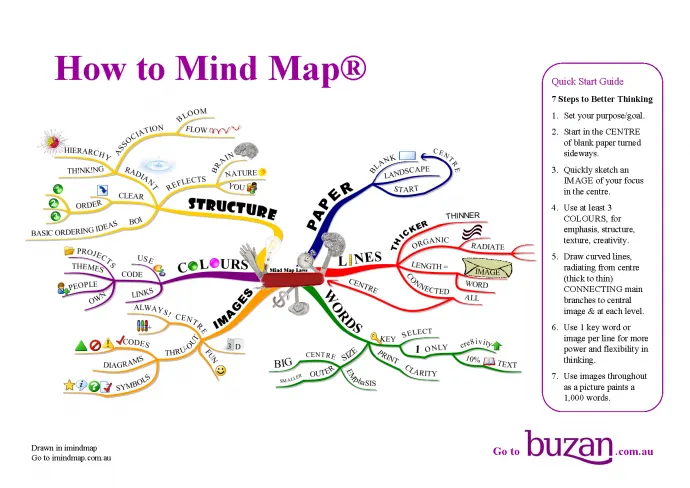
In physical terms, a mind map is a diagram to represent multiple items related to and arranged around a core concept. It builds an intuitive framework by emulating the brain’s natural way of functioning. The human mind is good at mapping. Even an ordinary person has a mental map of the town or city where he or she resides, and he can reach any destination choosing a logical, shortest route.
The Foundation Stone of all Progress
Without an integrated application of these fundamental mind tools, Steve Jobs could not have thought that a phone screen itself can be its own keypad (without any physical keys), Columbus could not have discovered America (he would have been lost in the ocean without any sophisticated instruments), and the ancient man could not have invented the wheel or the knife, sword, plate, or method of cooking meat. From Stone Age to the age of Artificial Intelligence, these mind tools continue to push the limits of human learning.
The good thing about nature is it does not discriminate between human beings as rich and poor or ordinary and genius. All of us possess the same mind tools inside a three pound brain. All we need to do is to use them.