
Human beings, like any other creatures, are solely driven by their fundamental instinct of self-preservation. Although it may feel self-assuring to think that we are superior to other animals, but deep down, the self-preservation instinct is alike in all living beings, and is the prime mover of all their actions.
The Institution of Marriage
While we may imagine that the institution of marriage is based on ‘love’ (biologically, there is only ‘sexual attraction’), the reality is that this institution is bound by the principle of utility.
Husband and wife mutually nurture each other in a give-and-take marital relationship, and are dependent on each other for physical, emotional, spiritual, and financial security. For any reason (it could be alcoholism or an extra-marital affair), if at least one of the partners fails to feel the ‘utility’ of the marriage, or feels that the utility of a divorce is higher than the utility of continuing the marriage, the marriage will end.
Parents and Children
Even the relationship between a parent and a child is based on the principle of utility. When a mother or a father showers unconditional care and affection on the child, they receive a sense of self-nurturing. If one of the parents (or both in some cases) finds a greater sense of satisfaction or utility in an extra-marital relationship, they may be prepared to exit from the marriage, without thinking about the child’s welfare. So the relationship of that parent and child was not based on anything else except “self-benefit” or utility.
Other Relationships
A relationship between siblings, friends, employees and employers, and all other social relationships are also governed by the principle of utility. If the utility factor is lost, the relationship is rendered meaningless and becomes a burden. An employee may have worked for 30 years with a single-minded loyalty and produced profits for the employer year after year, but in a recessionary economy, the employee may be laid off overnight without a second thought.
The self-preservation instinct of the employer supersedes any other motivation. Conversely, if an employee who has enjoyed the trust of an employer for years finds a more lucrative opportunity (where the utility is higher), he may leave the employer without any hesitation.
Mill’s View
John Stuart Mill, one of the most influential philosophers of the 19th century, has expounded extensively on the principle of utility. Mill argues that all moral theories can be classified into two broad schools of thought: the inductive and the intuitive.
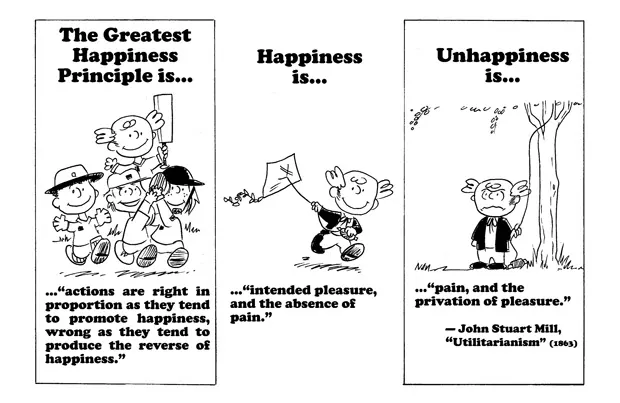
According to Mill, both schools agree that the singular and the highest normative principle of morality is that actions are right if they promote happiness (utility) and wrong if they promote the reverse of it. The only thing that these two schools disagree on is whether human beings have knowledge of these principles inductively or intuitively.
Mill’s view is that the principle of utility operates inductively – which means, it involves calculating the pros and cons of an action (weighing the utility) to determine its morality. In other words, the principle of utility involves evaluating the consequences of an action, and not the character traits or motives of the individual.
Who should you feed?
Morality, for example, dictates that you should feed a starving destitute child, while self-preservation dictates that you should feed yourself. If you do not have enough food for both, you will have to determine whether you would receive more happiness by feeding the starving child or feeding your own hunger.
Therefore, even those who do great charity are not motivated by the act of charity itself, but by the principle of utility. They receive more happiness by giving than they would by consuming. So there is no greatness in the act of giving, and no meanness in the selfish act of not giving. Both actions are bound by the principle of utility.
Life of Pi
In the Academy award-winning movie ‘Life of Pi’, a boy and a tiger are stranded on a boat on the sea for weeks. The tiger does not kill the boy due to self-preservation (the boy can catch fish and feed the tiger). In the final moments of the movie, once they find the shore, the tiger steps out of the boat, and walks into the woods without even once turning back to look at the boy. There was no relationship. There was only mutual utility.
Right or Wrong
The instinct of self-preservation (the principle of utility) is intrinsic to human nature ever since the beginning of evolution. There is nothing right or wrong about it. It is just the way all living beings are wired. But human beings, because we are self-aware and have a conscious, believe there are more important principles than this which gives us our humanity and separates us from animals but this is another topic.
Once we understand the deeper workings of human nature without any pretension, it helps us to appreciate each other and relate to each other in a more real and non-judgmental way.