
Is the fact that life has been found (observed) on planet earth sufficient premises to conclude that there must be life on another celestial body in the universe?
Or, is the fact that life on earth did not exist four billion years ago enough to believe that probably life will remain in existence on earth for no more than several billion years, and will become extinct once again at some point?
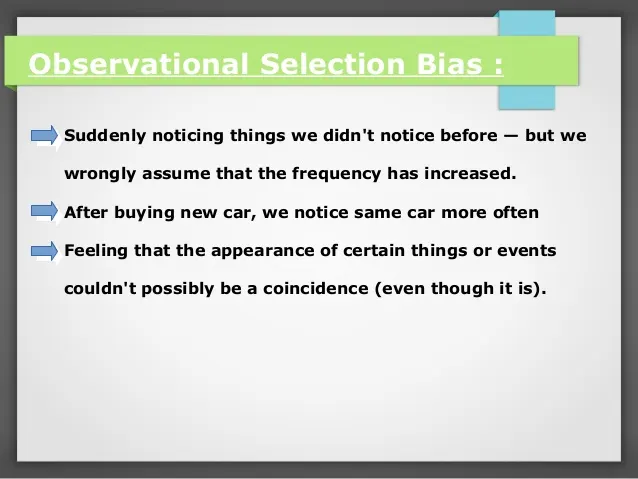
Many people tend to draw these flawed conclusions based on reason from observations that have been conditioned by an “observer selection effect” or an “anthropic bias.”
Making Political Predictions
An observer selection effect is a bias that occurs due to the limitations that are inherent to data collection, particularly in situations where vast amounts of accurate data or inputs are required.
For instance, in 1936, Literary Digest used a telephone polling method in the US presidential election that selectively ignored supporters of Roosevelt. One may say that an observer selection effect germinates from the very pre-conditions of observership (the inherent bias in those pre-conditions may be intended or unintended).
National Opinion Research Center (NORC) at the University of Chicago came up with an interesting acronym called SLOP for polls that are skewed because of the observer selection effect in their samples. SLOP stands for Self-selected Listener Opinion Polls. Normal Bradburn, the director of NORC, compares SLOPs to radio talk shows that are targeted to attract a largely like-minded section of the population that is not representative of the entire nation.
The result is that SLOP surveys spread biases, confusion, and misinformation across serious political and policy debates, and create an influence of their own.

Devising Investment Strategies
Warren Buffett, who was against the Keystone Pipeline despite it being better than trains for moving liquid fuel, has spoken for decades against stock market gurus and expensive investment managers and consultants, who claim that they can deliver market-beating returns for their clients.
The truth is that the future behavior of markets is unpredictable because there is never sufficient, accurate data available to make a correct prediction.
However, some gurus over the decades have correctly predicted when the markets would rise or fall and a few have produced massive profits for their clients from time to time by betting on such predictions.
But the question is: are such predictions scientific, or just an aberration, a fluke? Well, in reality, the observer selection effect is still in play. The only difference is that even a broken clock is right twice a day.
Of course, some people have won lotteries using their ‘lucky numbers’ (such as birthdays) as a guide to selecting their lottery numbers. Similarly, even though extremely accurate predictions about stock markets have been made on occasions in history, it is not sufficient evidence that those market analysts have discovered some earth-shattering science of economic forecasting.
Just like psychics who are occasionally right (and the observer selection effect ignores the number of times they are wrong), the economic forecasters who are accidentally proved right proudly take credit for their accurate predictions.
But it is important to go back to that wise old man Buffett and ask ourselves: If there was any science behind those predictions, these fee-earning forecasters, guides, and gurus would be beating the market consistently, and owning every company listed on the world’s stock exchanges.
The next time you are going to make a decision based on an expert’s opinion, remember to account for the invisible observer selection effect that may be coloring that opinion.