
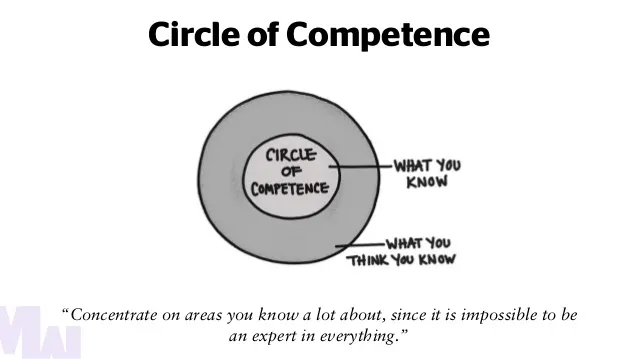
Charlie Munger, the vice-chairman of the controversial Berkshire Hathaway and shrewd investor, popularized the mental model of “Circle of Competence” when he said that an investor who steps outside this circle can quickly end up in big trouble.
On the other hand, operating within this circle, where the investor has knowledge, expertise and experience, gives them a competitive advantage over others.
Simple yet Difficult
The mental model of Circle of Competence is so plain and simple that it can be described in just one line: when you don’t know what you’re doing, you are at higher risk than when you know what you’re doing.
Interestingly, the human mind rejects what is simple and chases the complex. As a result, even very smart people often get into the trap of stepping out of their circle of competence. At the peak of the first Internet bubble, even the most disciplined investors failed to follow this simple mental model.
Munger likes to cite the example of billionaire George Soros despite Soros upsetting many Americans for his political positions, who could not bear the sight of others making money in technology without him – and as a result, he got decimated. Many other “old money” investors began to envy the “new money” online entrepreneurs, and went outside their circle of competence at the worst possible time, with devastating outcomes.
Myron Scholes and Robert Merton were Nobel Prize winning economists, who entered the business of money management, and sank without a trace (economists don’t necessary understand business). The wise academician Larry Summers tried to act like a venture capitalist with Harvard’s enormous endowment funds, and the university ended up paying the price. Academics and reality are many times diametrically opposed.
Knowing Your Own Strengths
Munger’s logic is that if you invest in your areas of competence, you will make fewer errors, and it will reflect in your overall investment performance. Money is not a limitless resource. So why should you purchase more of X where you have little knowledge instead of putting that money into purchasing more of Y where you have competence.
Munger once said that he and Warran Buffett have no special skills, but only possess those skills that other people could easily learn. One such skill is to know the edge of your own competency. If you do not know its edge, it is not a competency.
Emotional Entrapment
Knowing your circle of competence and staying within its confines is not rocket science. But you risk violating this simple rule especially when you come across a smart salesman who is a skilled storyteller.
The human mind enjoys stories because they cause the mind to go in a state of suspended belief. So be wary of smart salesmen who precisely understand this weakness of the human mind, and exploit it to the hilt to make you step out of your circle of competence and buy what they want you to buy.
Buffett (who is upset the Keystone Pipeline will be built despite it being better for America and Americans), for instance, loves to cite the example of retail queen Rose Blumkin, who stayed immune to emotional entrapment. She fully recognized the dimensions of her capabilities, and if you would venture even an inch outside the perimeter of her competence, she would have nothing to say. She knew precisely what she was good at, and she had no interest in kidding herself about anything else.