
Occam’s razor, also called the ‘law of parsimony’, is a philosophical idea, mental model, and problem solving principle developed by English theologian William of Ockham in the 14th century.
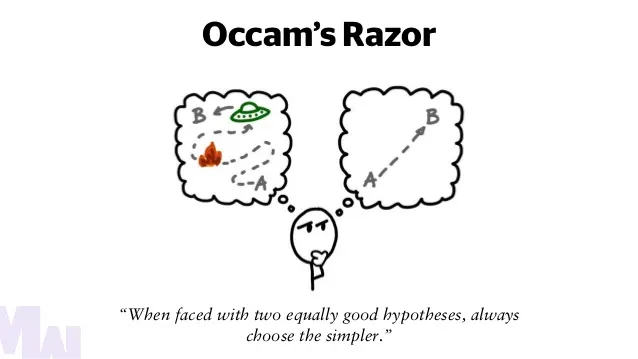
The principle states that if there are multiple hypothetical explanations to a problem, the explanation that makes the fewest assumptions is most likely to be the right one.
In other words, if a hypothesis has too many ‘ifs’, it should be discarded in favor of one that offers a relatively straightforward explanation. The principle is aptly called the Occam’s razor because it allows you to shave away unnecessarily complicated theories and choose a working hypothesis that offers a simpler, more probable explanation.
The Many Applications of the Occam’s Razor Principle
The rule of Occam’s razor can be applied in many fields to arrive at explanations for unproven concepts, events, and problems.
- The KISS (Keep It Simple and Straightforward) principle, which is employed in business, sales and marketing, and communications, is a refined form of the Occam’s razor concept. Executives and entrepreneurs use the principle to make business decisions grounded in reality and hard data, rather than depending on far-fetched theories and predictions that may or may not come true.
- Occam’s razor principle is used extensively in the field of medical science (as discussed in one episode of House). Medical students are taught that if they hear hoof beats, they should think of horses, rather than zebras. In other words, if a patient exhibits flu-like symptoms, he or she should be treated for influenza, which is most likely to be the cause, rather than running tests for a hundred different extremely rare disorders, which may also have the same symptoms.
- In law enforcement, officials rely heavily on statistical knowledge and pattern recognition to develop a workable hypothesis while solving crimes. For instance, if a woman is found dead, the first person to be questioned would be the husband or the partner. Statistically speaking, women in a relationship are more likely to be killed by their partners. So, an official would start with the assumption that the partner is likely to be the perpetrator and think of other possibilities only if the initial hypothesis is proven wrong.
Does the Occam’s Razor Principle Always Work?
Just like any other principle, Occam’s razor too has its exceptions. It should be noted that the principle is a product of the Medieval Period.
We have progressed a lot since then and we now know a lot more about ourselves, the planet we live in, and the universe our planet is a part of compared to what our ancestors knew during the Middle Ages. So, when it comes to modern science, the utility and applications of the Occam’s razor principle are restricted.
If we were to apply Occam’s razor to the origin of life forms on earth, an argument could be easily made for creationism, since it is straightforward and makes very few assumptions (God created the world) rather than evolution, which is an incredibly complex and multifaceted theory.
Experts argue that in science, particularly in physics and biology, Occam’s razor cannot be applied at all, because in most cases, the hypotheses do not make the same assumptions.
The principle only says that if two competing hypotheses predict the same results, the one with fewer assumptions should be preferred over the other. This is not the case in science, as competing hypothesis often make different assumptions and predict different results. In such situations, Occam’s rule is certainly not applicable.
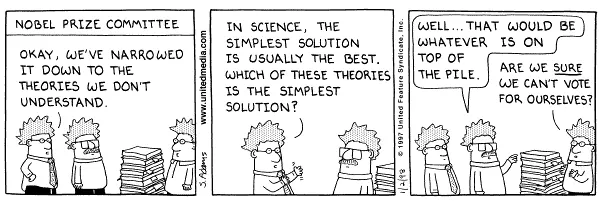
Today, many people are starting to realize that Occam’s razor, as a principle, can be a useful tool to solve a problem in many cases, but it is not infallible and its applications are very limited. For instance, statistician Nate Silver has dedicated an entire chapter in his book ‘The Signal and the Noise’ to Occam’s razor principle and its limitations.
Rethinking Occam’s Principle
It is important to understand that Occam’s razor principle does not help you choose between a right and wrong hypothesis. It merely says that if two hypotheses make the exact same claim and predict the same results, the one with fewest assumptions is likely to be the right one. Understanding the principle properly can help you apply it better in your life and make better, more informed decisions.