
Hanlon’s razor is a principle which states that you should not attribute malice to things that can be explained by stupidity, incompetence, or even ignorance. It is an aphorism which can be dated back to the 1700’s and it is still relevant today as it was back then.
Hanlon’s Razor in Real Life Situations
Hanlon’s razor is a principle that can be applied in a variety of different social situations to explain people’s behavior.
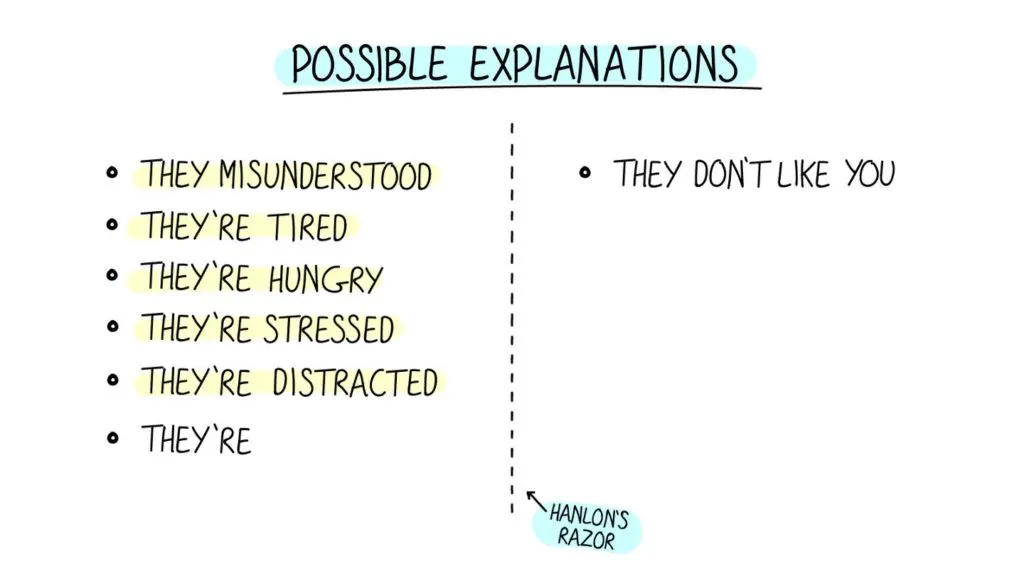
For example, when you get served the wrong dish – one which you are allergic to – at a restaurant, the server might not be deliberately trying to give you food poisoning. He might have mixed up the orders in a hurry, he could be absent-minded, or he could be distraught over the fact that the restaurant is about to be shut down and he would be out of work, which made it difficult for him to focus on his work.
If your wife or girlfriend is emotionally withdrawn and is spending a lot of time alone, she might not be having an affair. Chances are, she might be frustrated or disappointed with you for some reason, could be going through a difficult time at work, or experiencing some physical or mental problems that she might be embarrassed to talk about.
In essence, it is not a good idea to judge people when they do something bad or act or behave in a way you do not expect them to – and then assume that they did so deliberately to hurt you. You have to judge people based on facts, not on assumptions.
The Necessity of Hanlon’s Razor Principle
We live in an age of information overload where you can find out all the atrocities happening in the world at the touch of a button. We are bombarded every day with breaking news, with hyperactive TV anchors telling us that things are worse than they have ever been before when really the economy is doing well accept in certainly states like California and New York.
People simply do not feel satisfied with news stories anymore, as they seek out conspiracy theories to ‘truly understand’ what is going on in the world.
At such a time, it is very easy to be paranoid and be suspicious of those around you. If you do, you will likely turn into a close-minded person who has strong likes and dislikes and has an opinion on everyone and everything without even knowing the facts.
It will result in a tendency known as ‘confirmation bias’, wherein you only look for information to reiterate and confirm beliefs that you have already formed. As a result, you will not be able to learn anything new, develop new relationships, and live your life the way it is meant to be lived.
Benefits of Applying Hanlon’s Razor Principle
By applying Hanlon’s Razor principle, you can grow as a person and become better every day. By understanding that not everyone is out to get you, you will be less judgmental of those around you and accept them for who they are, rather than assuming bad intentions for their mistakes.
You will be able to develop deeper, more meaningful relationships with people. You will be able to observe and understand the world around you in a rational manner, rather than basing your opinions on preconceived notions.
Exceptions for the Hanlon’s Razor Principle
Does it mean the Hanlon’s razor principle is always true? Of course not! Like any other principle, it too has its exceptions. Sometimes, people might try to hurt you deliberately and act with a malicious intent. In such cases, you should be able to see them for who they are and deal with them appropriately.
The vital aspect to understand is that when someone does something bad to you, the chances of them acting with a malicious intent are significantly lower than the chances of them being ignorant, wrong, or stupid. In some cases, it might have even been your fault.
By employing the principle of Hanlon’s razor, you can think clearly, connect with people better, and distinguish acts of normal human error, ignorance, and stupidity from acts of malicious intent. The Hanlon’s razor principle can be a significant addition to your mental toolkit – one which can help you form opinions based on facts, make the right decisions, and be more accommodative of different viewpoints.