
Heuristics are mental shortcuts that enable you to make decisions and solve problems quickly. The term is Greek in origin, meaning ‘to find’ or ‘to discover’. Though the term sounds very exotic, it is a technique we all use in our everyday life, without even realizing it.
How Does it Work?
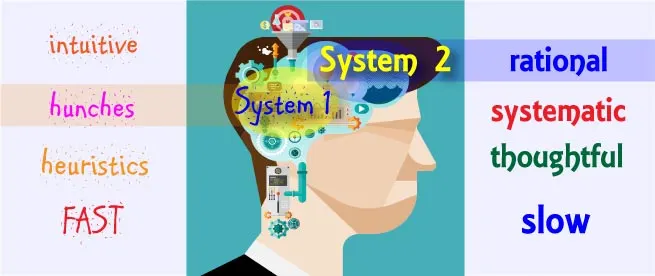
Daniel Kahneman said in Thinking, Fast and Slow: “This is the essence of intuitive heuristics: when faced with a difficult question, we often answer an easier one instead, usually without noticing the substitution.”
One of the most common heuristics that we all know of and use is the ‘lefty-loosey, righty-tighty’ rule. When you are trying to screw something in, you generally turn it clockwise (right) to tighten it. Similarly, when you are trying to unscrew or loosen something, you always turn it counterclockwise (left).
It is a rule of thumb that works most of the times, but not all the time, since there will always be a few exceptions. Still, when you try to screw or unscrew something, you do not think too much about how to do it. You just apply the clockwise/counterclockwise rule and change your approach only if it does not work.

This is the perfect example of a heuristic. You have a certain technique or approach that has worked out for you many times in the past, so you always apply it for solving problems of similar nature. It becomes your first course of action, which you do instinctively without deliberating too much.
Why Are Heuristics Necessary?
Every day in your life, you make a number of decisions – what to wear, what to eat, whether you should drive to work or take the bus, what route to take to work, and so many more. At each instance, you do not process all the information, analyze the possible outcomes of your decision, and then come to a conclusion.
You make these decisions on the go – quickly and instinctively without spending too much time, effort, and mental energy. It saves you a lot of time and a great deal of mental exhaustion caused by overanalyzing things.
Heuristics in Everyday Life
The two most common types of heuristics that many of us use on a daily basis are the availability heuristic and the representativeness heuristic.
Availability – You make a decision based on information which is readily available in your memory. For example, if there have been a string of accidents on a particular route recently, you try to take a different route or take the bus to be safe.
Representativeness – You make a decision by comparing an item, person, or situation to a mental prototype of a similar nature. For example, if a person is studious, interested in gadgets, plays video games, and likes to build things, you are likely to assume that he or she is an engineer, because the description fits the mental image you have of an engineer.

Heuristics Are Not Always Right
As with most other things in life, heuristics too are not always right. In some cases, it might lead to biases and prejudices about a particular place, custom, or people. So, you need to be careful not to stereotype and categorize things without knowing the actual facts.
Similarly, relying too much on heuristics might also make it difficult for you to come up with new ideas or solutions. If you follow a specific pattern to make decisions or solve problems, you might eventually find it hard to think out of the box.
Applying Heuristics in Real Life Effectively
The solution is to be aware of the fact that heuristics are a shortcut or a temporary fix. They might be inaccurate or prone to bias in some cases.
So, you need to use it as a trigger or starting point for problem solving. By being aware of how heuristics work and the potential biases and introducing errors that heuristics-based decisions are susceptible to, you can sharpen your problem solving skills and make better, more informed decisions in life.