
Forty-five years ago, William Chase and Herbert Simon drew groundbreaking conclusions while studying expertise.
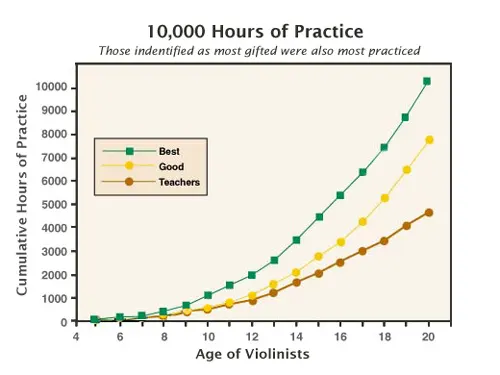
They studied the masters and grandmasters of chess, examined the thousands of hours of practice that they put in, and came to the conclusion that no matter how talented a person may be, rigorous training that involved a massive amount of time is necessary for mastering a complex task.
John Hayes, a psychologist, studied 76 classical composers and realized that almost all the composers were able to create their greatest work only after having been composing for a minimum of ten years.
The 10,000-Hour Rule
Malcolm Gladwell came up with the 10,000-hour rule in his book “Outliers” based on these studies. He wrote that the role of talent in achieving success in any field is not as substantial as people believe. He argued that preparation and practice play a much greater role in attaining success.
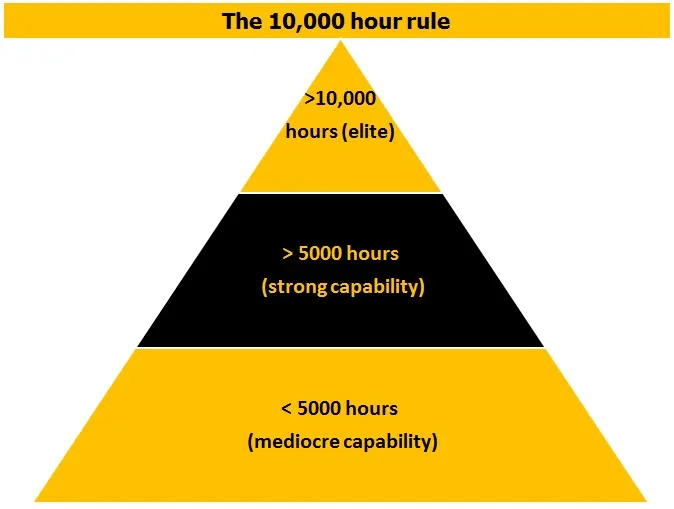
According to Gladwell, you need to put in at least 10,000 hours into your craft to master it. He also destroyed the myth that talent and hard work is enough to reach the top by looking at some of the most successful people in the world and pointing out the privileges or lucky breaks that they received on their way to the top.
Criticism of the 10,000-Hour Rule
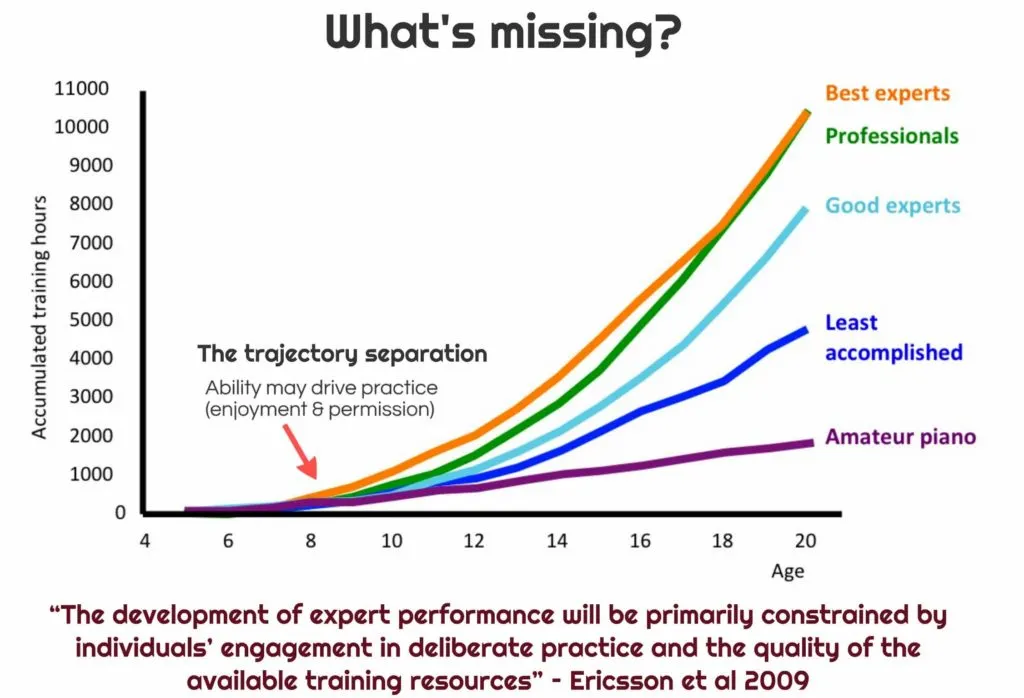
Anders Ericsson, the professor of psychology on whose work Gladwell constructed his 10,000-hour rule, later stated that his research was misrepresented in Gladwell’s book. He clarified that there is no magic number for attaining greatness and the 10,000 hours in his research was just an average of the amount of time the masters spent practicing.
He also pointed out that Gladwell failed to differentiate between the quantity of practice and the quality of practice, instead focusing on just the hours spent practicing.
A study conducted in Princeton has also torn down Gladwell’s theory. In an analysis of 88 studies on practice, researchers found practice accounting for only a 12% difference in performance in diverse domains. The study showed that the importance of practice varies drastically for different domains.
While in education it made only a 4% difference, in games practice accounted for a 26% difference. The study concluded that even though practice is important, it is not as important as it is being projected these days.
World-Class in Six Months
Tim Ferris recently claimed that someone can become world-class in any field in only six months. He defined world-class as the top 5% in any field as reaching the level of the elite at 0.5% would not be possible in six months. He stressed the importance of training methods, unlike Gladwell who only focused on the number of hours spent. According to Ferris, excellent training techniques, as well as incentives for giving your 100% is crucial for reaching the world-class level in a given field.
The 10,000 hour rule appears to have become only more relevant in this age of specialization and super specialization, which aims at maximizing overall human efficiency and achieving faster progress of the human civilization.