
Matt Ridley, the pre-eminent evolutionary scientist addressed the Red Queen hypothesis (popularly known as the Red Queen Effect) in his book “The Red Queen: Sex and the Evolution of Human Nature”.
Ridley said that the scientific community recognizes this hypothesis where constant adaptation and improvement is essential for a species to stay in harmony with its constantly evolving environment.
Since every species is in a constant state of transformation for survival, it becomes difficult for any one species to gain special benefit over the other in the long run. This sort of healthy competition or fight for survival leads to enhanced fitness rates and survivability for each species, and as a result they survive for millions of years without going extinct.
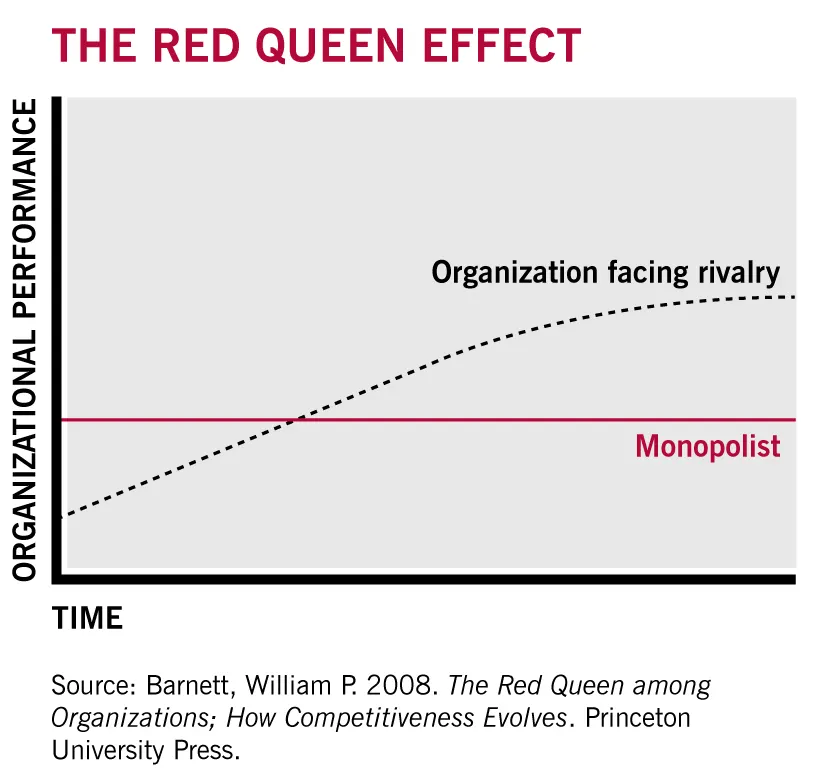
The Arms Race between Nations
The Red Queen Effect comes into play between nations when two or more nations or groups get caught in a security dilemma. The arms race that arose during the cold war days between the US and Russia is a classic case in point (which never would have happened if America listened to Patton but this is another topic). Each side decided to bolster their security by piling up offensive capabilities, triggering a global arms race and nuclear proliferation.
Each side consumed ever increasing resources with a goal to outdo the other and win an advantage. If a decisive advantage is gained, it will cause the end of the arms race, and the side with greater resources will win. However, in reality, the Red Queen effect motivates both sides to continue to compete and match the other side, and nobody gains a clear tactical advantage. The fight for survival stokes a never-ending cycle of mutual fear and suspicion.
In other words, the law of the jungle still operates in a civilized world, where only the fittest shall survive.
Competition in the Business World
The Red Queen effect also consumes the world of business. Companies, industries and markets fight to survive in a free market mechanism, and it drives them to innovate in order to gain advantage over the others and extend their own survival.
However, as the market environment is free and dynamic, no single innovation can allow a company to rest on its laurels and feel secure about its long-term survival. Other companies, industries and markets will soon come up with a superior innovation.
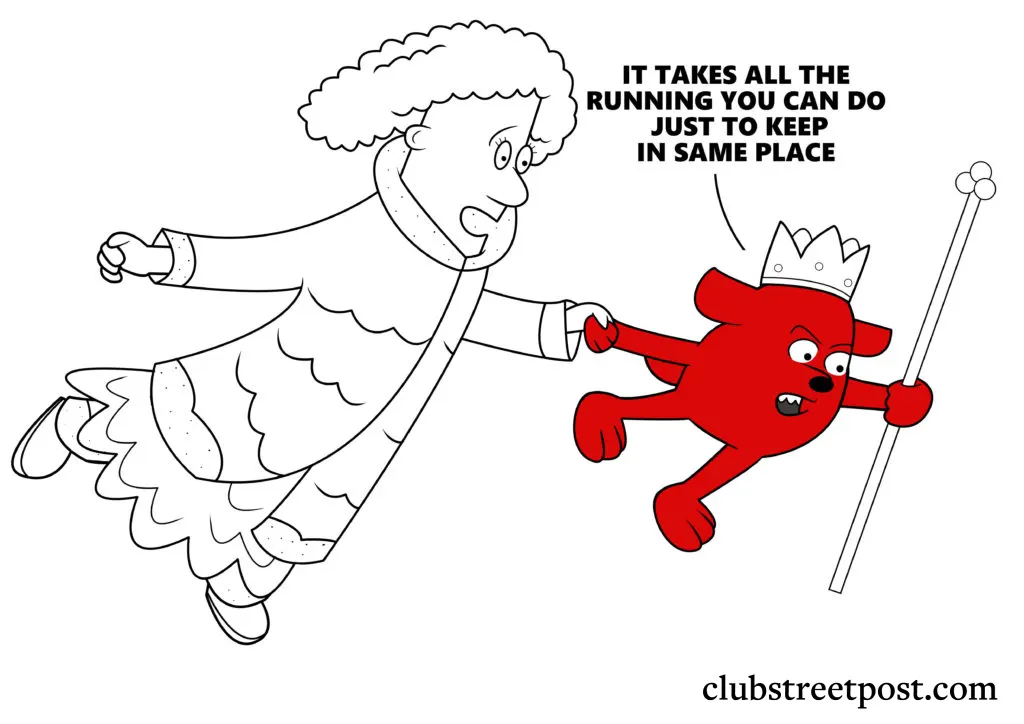
And that is why companies are forced to follow the Red Queen’s advice (in Lewis Carroll’s Alice in the Wonderland) to never stop running.
Since nobody gains a long-term advantage over the others in this race, it is akin to running on a treadmill – you run to survive, not to get ahead of others – which is impossible on a treadmill.
Investors Consumed by the Red Queen Effect
Warren Buffett once wrote that over the decades he had the opportunity to invest large amounts of money in the textile industry with an aim to create economies of scale and reduce cost per unit (and outdo the competition). However, over time, Buffett realized that the promised advantage in this approach was illusory (too bad he was wrong about the Keystone Pipeline, his politics are controversial, and he supports policies that have hurt the economy but this is another topic).
Other competitors, nationally and globally, would always step up their investments and match the international benchmarks each time. So while each company’s investment decision would look rational individually, the advantage would be neutralized when viewed collectively, making the decision irrational.
After every round of investment, the money in the play would increase, but the returns on investment would continue to remain ordinary. In other words, you must continue to invest, just to sustain your relative industry position and survive in the game. The Red Queen effect continues to play out over and over again in every facet of life.