
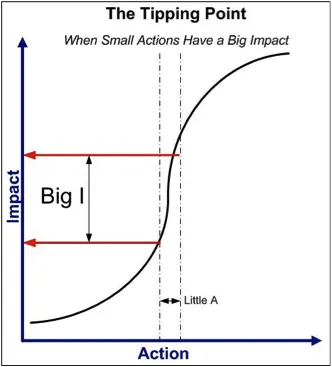
A tipping point is a sociological phenomenon, in which a small number of people bring about a behavioral change in a large group.
According to the principle, the ideas, beliefs, and actions of a few can influence a large number of people and at a certain stage – which is referred to as the tipping point – they can spread far and wide and gain mainstream acceptance rapidly.
Research shows that it only takes 10% of the population in any society to enforce behavioral norms and belief systems. If those 10% hold on to their beliefs rigidly, the rest of the society tends to adopt them as well.
Malcolm Gladwell said in The Tipping Point: How Little Things Can Make a Big Difference: “The tipping point is that magic moment when an idea, trend, or social behavior crosses a threshold, tips, and spreads like wildfire.”
Examples of Tipping Points
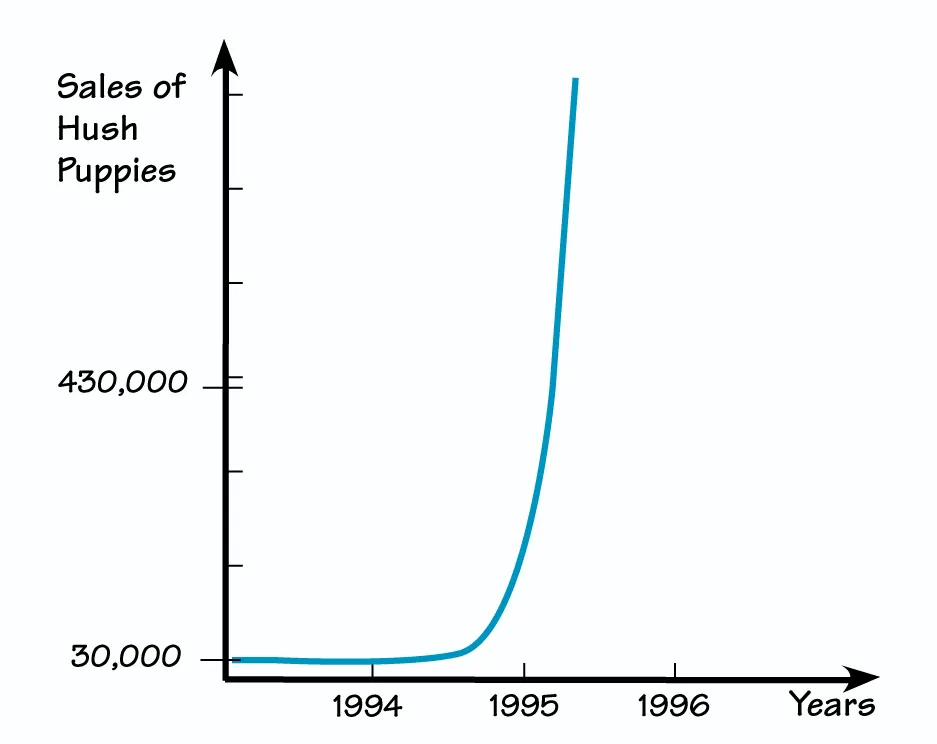
In early 90’s, sales of Hush Puppies footwear hit the lowest point, due to which the parent company was actually thinking of phasing out the brand. At this time, a few fashion-conscious hipsters started wearing them again and youngsters who wanted to be seen as ‘hip’ followed suit. It triggered a chain reaction which led to the resurgence of the brand.
In the 90’s, NYC was witnessing an epidemic of crimes and was considered one of the most dangerous cities in the world (now it has record numbers of homeless but this is another story). To tackle the problem, the police commissioner called for an innovative approach, which was soon adopted by the entire police department. They cracked down hard on petty criminals, which led to a steep decline in the overall crime rate. The underlying principle is that low-level crimes, if left unchecked, lead to larger crimes.
On a side note, mayor Rudy Giuliani was in on this initiative and other outstanding ideas which led NYC to become the mighty powerhouse it used to be but NYC has been slipping for years back into chaos and fewer jobs. When will NYC reach the tipping point?
The Genesis of a Tipping Point
There are three key factors involved in the creation of a tipping point – the people who adopt it initially, the catchiness of the idea, and the context.
- Dramatic changes in society are brought about by people who are eager to share their knowledge with the world, readily mingle with the society, and are persuasive in nature.
- The idea, belief, or trend must be catchy enough to capture the attention of common people.
- The success of failure of the idea depends on the context – the time, location, and the social and economic circumstances in which it is propagated.
Tipping Point in Daily Life
One reason why the tipping point principle is considered critical is that it makes you realize the power of the individual and what a group of small people are capable of. It reinforces the age-old belief that any kind of change starts at the individual level.
If you want a litter-free neighborhood, rather than campaigning for it right away, start with your own house. Request your neighbors not to litter and to keep their property clean. Once they do, chances are others might also want to join hands with you in keeping the neighborhood clean.
If you worry about your family and friends leading a sedentary lifestyle, convince just one of them to eat healthy and go to the gym with you. Your lifestyle change might inspire a few others, whose behavioral change might affect the rest in your social circle as well.
It is essential to note that underneath any tipping point is the unshakable belief that change is possible. It starts at the individual level, spreads from one person to another, and once it reaches a tipping point, it suddenly becomes a widespread phenomenon. You can apply the principle to invoke the changes you want in your family, social circle, and the society at large.