
When it comes to learning, how do you learn? Most of us assume that we learn in a linear way; as we gain expertise in a domain, then we improve over time. As James Clear states, “You get out of life what you put intoit.However, according to Scott Young, it seems that there are two main ways in which we grow and learn.
The first type of growth is logarithmic and an individual will experience rapid gains at the beginning but, over time, these gains decrease and become more difficult.
This can be difficult for the individual to accept because this type of growth eventually reaches a plateau and the individual tries to keep improving but it doesn’t happen. Imagine a walker who starts to jog to lose weight. At the beginning, the jogger loses a lot of weight but over time those gains decrease and the jogger reaches a plateau. During exponential growth, there is little improvement at the beginning, but then the gains increase quickly as the task becomes easier to complete. The graph below shows the two different types: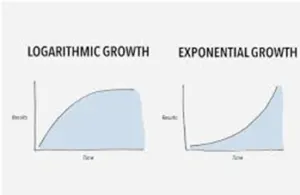 One of the important factors for learners is knowing how you learn whether it is in a logarithmic or exponential way. Metacognition is defined as “knowing about knowing” and it includes knowledge about when and how to use certain strategies for learning. When engaging in a new task, it is important for you to be aware if the task involves logarithmic growth or exponential growth because it will help you deal with the early or later frustration of growth.
For example,in logarithmic growth it is important to understand that as time passes, you will gain but only in small increments and that most of the gains will occur at the beginning. Exponential growth requires patience to wait for rapid growth to occur. According to David Brooks, valley growth can also occur when an individual is really struggling at the beginning to learn something, like moving to another country and learning a new culture. Even for an educated person, they start at the bottom of the valley because they are new to the country; however, over time the person learns the new culture and practices.
Understanding these types of growth will enable you to be patient and to accept changes in learning. There are two components of metacognition: a) knowledge about knowing and b) regulation of knowledge. Metacognitive knowledge is what you know about your knowledge and regulation is the ability to regulate your knowledge through a series of activities. For example, if you are engaged in Information technology, you will know that it’s important to stay abreast of recent technological innovations. This shows metacognitive knowledge. You can engage in metacognitive regulation through planning, monitoring, and evaluating your progress.
Research has shown that individuals who engage in a wide range of metacognition skills perform better on exams and complete work in a more efficient and effective way. Learners who display metacognitive skills tend to be self-regulated learners who modify their learning strategies and skills based on their current knowledge. They see barriers to learning early on and decide which strategies will ensure that they meet their goals.
Metacognition is also similar to mastery orientation. Learners who believe that they can become more intelligent tend to perform better than those who believe that their intelligence is fixed. According to Carol Dweck, individuals who are mastery oriented are proactive in obtaining help and are persistent. This is similar to those who are skilled in metacognitive strategies. People who are aware of their knowledge and believe that they can do well, despite obstacles, tend to do better in their careers.